Mason’s marks

My Dad once told me off for looking down as I walked. He thought it showed a lack of confidence, a shambling man of the future maybe, losing his way in life, pushing a tartan shopping trolley.  Yet I was looking at sycamore keys as they gathered below the kerbs, some washing towards the drains, others interlocking, making knots, arboreal daisy-chains.

My gaze in cities is up; previous generations put detail into their upper storeys that today we shun as wasted effort, wasted cost. Elaborate Ruabon brick patterns in Manchester, mock terracotta facades in Birmingham, or iridescent tiles in Mortimer Street. Cupolas and pediments, often out of eye line; leading, curved and cut in flowing patterns, visible only to pigeons and skyscraper window cleaners.

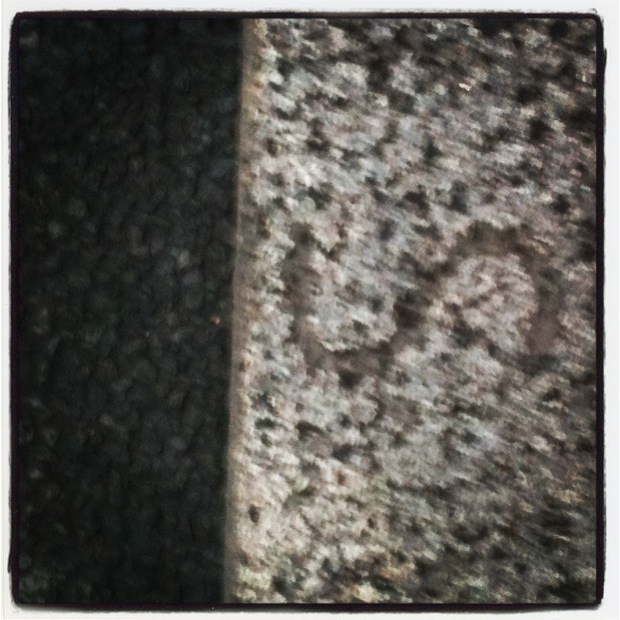
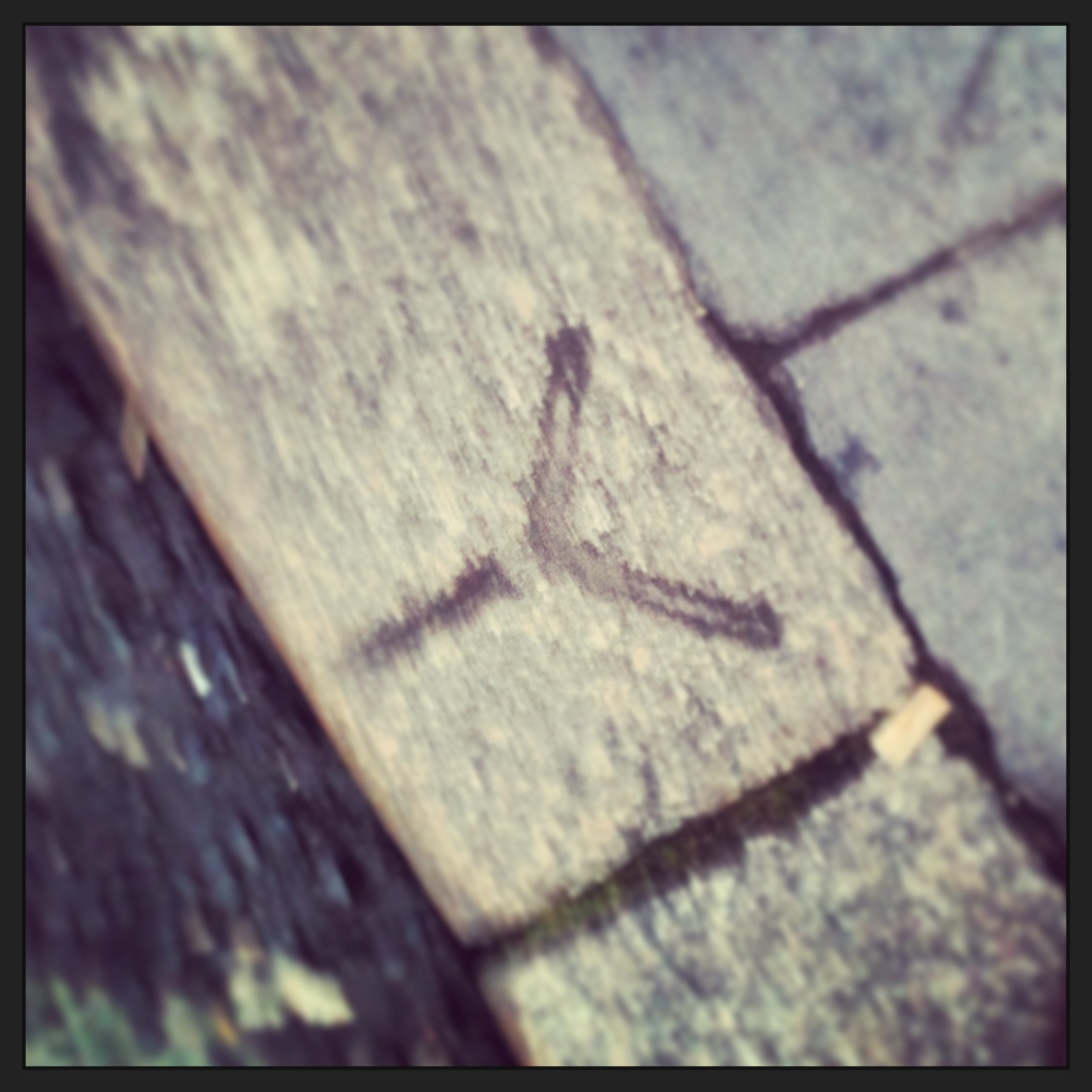
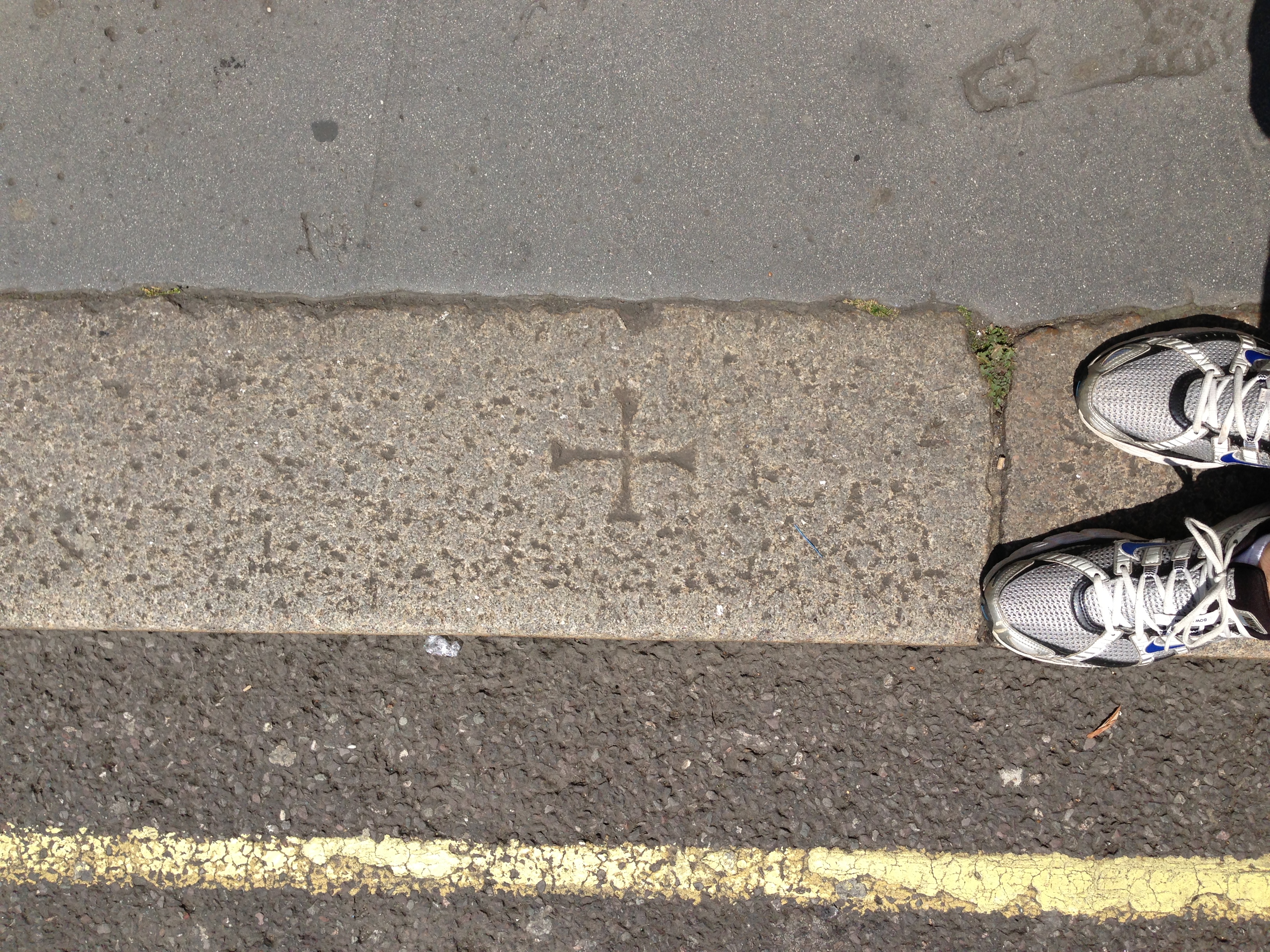
Yet there is merit in the downward glance too; wrought iron manhole covers proudly pronouncing their manufacturer. Thick glass tiles too, like old NHS glass lenses, which remind me of ‘Dan Dann, a  lavatory man’ in Carry on Screaming, for whom the tiles gave him his only natural light*.  But most of all, I’m intrigued by the mason’s marks on kerbstones.  Maltese crosses, diamonds, arrows, capital letters, even rune like symbols.  Were these early advertising? Merely a symbol of pride? Or perhaps a record for payment purposes?

IMG_2568 IMG_2566 IMG_0182

*That is, until Oddjob bopped him on the head and made his world go dark.

The Lighting Emporium

The old catalogues for Christopher Wray’s Lighting Emporium were as beautiful as the lights themselves. Thumb thick, with heavy gauge matte paper and deft touches of spot varnish, they oozed quality. And turning page after page,  lights of all denominations: art nouveau, deco, modern & antique, restorations, Moorcroft bases, Tiffany lanterns.  At one point, this was the largest chain of lighting shops of the country; manufactured mainly in Birmingham, in an old brick factory just off a ring road. It was precariously placed, like a wizard’s home that should remain unseen but peeks through the dimensions into ours.  The company is still going today, but in reduced circumstances. This picture tells a tale: the retail shop front, recently abandoned, sits in a tumbling brick former factory; slate roofs of different pitches; curving and angled drainpipes dash across precipitous voids; prominent chimney stacks, sprouting ferns and Buddleia.  It would have been, in its Victorian heyday, a works, a crucible of industry.  Today, it stands next to Birmingham’s ThinkTank – a futuristic building taking inspiration from the industrial past and Birmingham City University, an institution promoting, amongst other things, a scientific tomorrow.  It is a curious juxtaposition.

IMG_3140

Early autumn jottings

September 2nd
An early start to Herefordshire, and the first sense that Summer ebbs as Autumn flows. From the broad valley with the Cotswolds on one side, and the Malverns the other, the M50 is the apple route. It becomes immediately more rural, and grassy. Rather than illuminated signs telling you to “use hard shoulder when busy” here they just say “Soft Verges”, a polite warning not to break down as the hedgerows will swallow you up. Then, outside Ledbury, the apple trees begin, defiant, proud, spiky despite huge stands that map the rolling lie of the land. They are heavy with fruit.

September 11th
With a strange circularity today, I meet an old colleague Giles. He worked for an advertising agency in Edinburgh who my old company used, and in 2001, we were up in the Scottish capital in a ‘pre production’ meeting, a critical stage in making an advert where everything about the forthcoming shoot gets agreed. During the meeting we heard the whispers. ‘Have you heard what’s going on in New York?’. Diverting the focus of the meeting, we watched transfixed. When the towers fell, it was impossible to comprehend what was going on. The setting was so familiar, so much like a movie set, watching it felt like one. But it was only in the taxi on the way to the airport and the flight home, that what had happened sunk in. We flew home.

IMG_2337The Plane trees in London are beginning to hunker down in preparation for winter. Leaf edges are curling up and turning cello brown. Some fall early; walking between parallel rows, the gravity of expectation is almost palpable. I don’t know why Planes are so named; but I have a soft spot for their versatility and constitution. Their fruit hanging like posh Christmas decorations, bulbous, glittering and furry; unlike conkers they don’t seem to fall. The Planes have adapted to thrive, like urban foxes.

I wait for my train at the British Library. To work at the library café it seems you must have an Apple computer, but they seem to sell very few apples at the counter, only cakes and excessively crusty sandwiches. It is though, to paraphrase ‘the restoration man’, George Clarke, ‘a great space’ and time passes quickly.

September 14th
I ride 62 miles on my bike, but feel unwell throughout. The land however is bursting with health and vibrancy. Climbing over the Chase under trees, I glance up at the canopies overhead. With the strong light behind, the canopies form patterns like fancy pants wallpaper, Laura Ashley, Farrow & Ball.

September 23rd
With the passing of the Autumn Equinox the daily stride towards darkness begins. And so too the bustle of Autumn, everywhere activity. As the sap in the tree falls as the days shorten, so the wind can starts its ironic late Spring clean, loosening the leaves’ attachment to their home.

The light lingers long now, backlit, iridescent. A short walk against brooding dark skies sees the hills lit up with spotlights. Greens are greener; the autumn colours commence, duns, browns, burgundies, reds. And the puffs of falling leaves have started. The horse chestnuts are letting go all around, a leafy mulch on the pavements. Other are less forthcoming, the oaks are still green, the little coins of the beech are preparing.

September 30th
This morning, low mist hangs over the fields and in places hill tops jut through, floating on the clouds. The sun is low. Bright reflections and long shadows of a leggy man striding across the fields. Squinting. And in the distance a swan, wing up, preens, preparing to hunker down.
Steeple

A distant relative, an uncle at least once removed but more distant in terms of the knowing of him, I am aware of through story and hand-me-down snippets of information. Walter by name, a north countryman and bon viveur (some would say, a swanker) in life, lung cancer by death, steeple jack by trade. One story runs that to scare an ageing aunt he performed a hand stand on the blue clay ridge line of a 1930s terrace just off Canal Street.  I’ve heard tell that it was one handed. Embellished with time perhaps: but in essence, the lines of his saga weave consistently. A talented, braggish bloke, choppsy too; a showman, a great smoker, and at heart, a good man.  What’s certain is that he had a head for heights. Travelling around east Cheshire and south Lancashire repointing and repairing mill chimneys, brick and metal banded typically, 100, 200 foot high. Domestic work for cash, and for favours or back handers fixing up buildings with wind vanes and weathercocks. Once or twice he topped out church steeples – most often with lightning rods, less often with a Cross for light of a more divine nature.

IMG_2072_fotor50 odd miles away, today I live in the borderlands of Staffordshire and south Derbyshire, where the Trent, Tame, Mease and Swarbourne course across their flat, cobbled, gravelly confluence, snaking and splitting, the river banks edged with willow and ash; swans, wings arched back, hissing and spitting. Gravel pits shadow the river hereabouts where perhaps there should be levees, but as yet, no one has built on the flood plain so nature can feed the fields. Over the bailey bridge, tucking in your ears and edging gingerly, the ‘Derbyshire side’ of the river – actually a confusing hinterland where four counties intertwine – rises sharply as the valley cliff rises; the land has been heavily deforested, yet high hedged fields are verdant and rolling all the same. Occasionally an ancient tree stands sentinel in the middle, alone, proud. The villages are close-set and alliterative: Edingale and Elford, Haunton, Harlaston, Huddlesford. Their steeples too, rise sentinel – cleared of large stands of trees to block the view, they soar vertiginously, like poplars. At the bend in the road, the spire of Coton in the Elms stands out on a hilltop; from there, that of Lullington, hidden by yews close to, stands out clear, naked, beckoning; and from there, Clifton Campville, with its delicate spire of stone calls the eye like a comet with an earth coloured tail of mosses, liverworts and lichens.

Further north, the salty wind of the Irish sea blatters up Ennerdale, whipping the stands of conifers; their canopy swaying in unison like arms aloft as the ballad is sung. The fells rise quickly and rough here, drawing in tight, probing, pushing into the very heart of the mountains. The summits are on the bagging list: Scoat Fell, Pillar, Red Pike. One, cramped by its neighbour, is famous all the same; linked as it is by a stony and loose razor ridge, a gravelly, slippy arête, before a short, sharp clamber to a pyramid top: a mountain scribble on a beer mat. A child’s mountain. A mini Matterhorn, a Steeple of rock and scree.

Just the place, then, for a one handed hand stand.

Ikon

IMG_1806I met MJ for a catch up; his life more eventful than mine it seems, refreshed me. We talk and drank coffee, ate cake. Talked more.

Then we walked.

“But the beauty is in the walking – we are betrayed by destinations”

 Gwyn Thomas

He wanted to show me something. Up New Street, across Victoria Square, past Birmingham’s Museum and Art Gallery and it’s Victorian grandeur. And across Chamberlain Square in memory to a great Victorian Statesman. By contrast, ‘Paradise Place’ is hardly that, a ’60s concrete juxtaposition, not even of the brutalist kind, just the memorably ugly kind. But pushing on we emerged by the new library – our destination, I thought.

But no. we carried on, through the ICC then along by the canal basin to emerge in the mish-mash of bars, restaurants and corporate offices making up Brindley Place. All a bit so so. Yet there, crouching off a pedestrianised & setted alley just off Broad Street was our destination. The delightfully off-centred Ikon Gallery (http://ikon-gallery.org).

I wished I had been more prepared mentally, as it was it was all a bit of a mental assault. MJ talked me through some of the pieces – but what struck me was the space. Some, open, clean, airy. Others, darker, cavernous, troglodytic. Worshippers stood in muted silence, in awe. Other gaggles giggled and moved on.

Go there. Enjoy the art. Enjoy the space.

IMG_1805


Radiant House

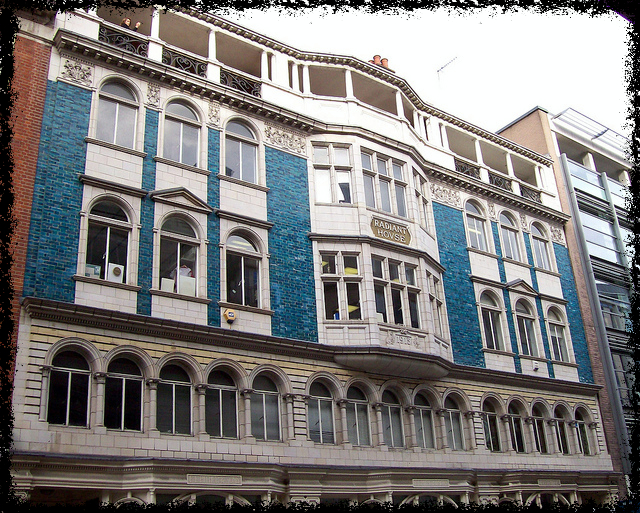
This is ‘Radiant House’ on Mortimer Street, just round the corner from my old office. I walked past it most mornings, always looking up, depending on the route I took from the station. I’m no architect nor architectural historian, but I know enough to see elements of classical styling with even touches of art deco (the wrought iron inserts on the top floor).  Radiant indeed. Would we see aquamarine tiles on a building today? Yet look. Just below the name of the building is a smaller inscription.  1915. The year of the Dardanelles. Gallipoli. The Second Battle of Ypres. It’s difficult now to imagine the mood of disquiet & national depression as losses mounted up.  Here is a beacon of hope, the building says. Radiant House_fotor

All along the water tower

September 2012

There are some things that exist solely in your peripheral vision.

I find it fascinating that for most of our waking lives we concern ourselves with immediacies: what do I have to do today? Should I buy x not y? What will my wife think if I do n? Wasn’t there something I needed to do by 3.30pm? What do I need to get done next week? The old mind talk.
Yet, there all the time, never leaping out sufficiently to become the star of the show, are all the fascinating objects, events, people in our peripheral vision. The supporting cast if you will. There is a psychological explanation for this – your brain, processing as it does, millions of pieces of data every day, has to prioritise. Most things get de-prioritised. They don’t help the important tasks of survival or mating or shopping. Then an event happens – someone points something out for example – and suddenly, the bridesmaid has a chance of being the bride.

I spent my early years in the foothills of the southern Pennines. A large part of my family are from Congleton (‘Congy’ to those determined to make it sound even uglier than it does already). It’s a archetypal northern mill town. The Pennines rising up behind the town. Tall, thin, stoic mills, smeared brown and black with the grime of age still gripping the banks of the riversides. Houses, intermingled, in short, sharp runs of Ruabon brick and grey gritstone. Many of my family were mill people; my gran still bore a scar by her eye where a blurring shuttle had loosed and struck her. The mills were part of the weave and weft of their being.

So it was for generations that the water towers, rising sentinel above the town, had formed part of their peripheral vision, just as they had for me. Born out of necessity on many fronts, but chiefly to ensure the local populace (read: workforce) were not decimated by diseases like cholera, water towers became a feature on the horizon of many towns across the British Isles.

Funny then, that after almost 40 years, there were multiple events that crashed water towers from peripheral to primary vision in my life. It started with a chance encounter with The Renovation Man on Channel 4. Quite literally flicking through the channels one evening, the soft Geordie tones of the presenter eulogised the beauty of Victorian industrial architecture. I paused, assuming he was referring to a station or grand town hall. In fact, it was a water tower. Thinking little more of it, I hit record and went to bed.

Saturday, two weeks later. My Saturday routine. Drop the children off at the dance & acting class, buy newspaper, retire to the library cafe; read, write, or think. And there, outside the window is the most impressive Victorian water tower you will ever see: five stories high; topped with mock Norman arches and simple crenulations. A stone plaque: ‘1866’. I had parked next to it for almost twenty years with barely a passing thought- only now after working elsewhere and seeing it less, did I stop and take it in.

I went home the same day and found the recorded ‘Renovation Man’. It was a fine water tower’ a beautiful cylindrical design with mixed brick work of red and blue and fine feature arches. A functional building but designed with the pride and attention to detail that today is deemed an expensive luxury.

Water Tower Congy iiAnd I recognised it. Not with a vague familiarity, but a real sense of connection verging on déjà vue. In fact it wasn’t the water tower that drove this feeling, but the site and its sister; right next to it was a more modern water tower – a simple white structure; tank resting, shrouded in a concrete skirt resting on columns. Two towers, next to one another. This was Congy, the twin water towers standing out proud on one of the hills above the town and 40 years of peripheral vision became pulled into stark, sharp focus in an instant.