Vogons

IMG_2525_fotorUntil yesterday, I thought that the Hitch Hikers Guide to the Galaxy was a work of fiction. Turns out though that Douglas Adams was more of a seer: the Vogons have taken over. Whilst we may not be threatened with an interplanetary bypass, they have infiltrated every Parish and Borough Council planning body up and down the land. They have re-written procedures. Made things more efficient. And made things utterly opaque.

Our neck of the wood is characterised by river floodplains – broad, meandering rivers, oxbow lakes, levees, river terraces and floodplains. Our soils are rich with lovely river cobbles, rills of quartz running through them from aeons ago, then worn smooth by hundreds of thousands of years of gentle fluvial frottage. Each cobble is matt and sullen when dry but lights up, glossy, pearlescent when wet, sparkling with mirror-like beauty. Between the cobbles is thick clay, smaller stones and grit.

It’s the bloody grit the Vogons want. From the air, the Trent snakes north east, broad and shallow, an ancient transport thoroughfare. But either side are the scars: gravel pits and mounds; the machinations of engineers, the machines of extractors. The Vogon planners are in on this and with the weasel word-tunes they play, they charm us lowly naïve snakes: ‘New gravel extraction will create 11 jobs’; ‘New habitats to be created on site of former gravel pit’; ‘New leisure complex and family play area for Burton’.

Thousands of years of our land, gone in a week. Miles of hedgerow, teeming with life, rent and pulled, ripped, slashed, burnt. The shy and secretive bat; their world destroyed – at least they can take flight and – hope; but not the rabbit and their warrens or the badgers and their setts. A small price to pay? Meadows destroyed; ancient rights of way, removed of diverted. The seasonal ebb and flow of the trees foliage, cleaved apart, thrown to the ground, dragged off. The sad cry of the corncrake or piping lapwing left for the reserves on Springwatch or Countryfile, like some perverse Truman show theme park.

Anger. We would have stopped it of course, had we known. How could this be? This won’t happen on our watch. But we didn’t. We didn’t care, apparently. It went through with no objections.

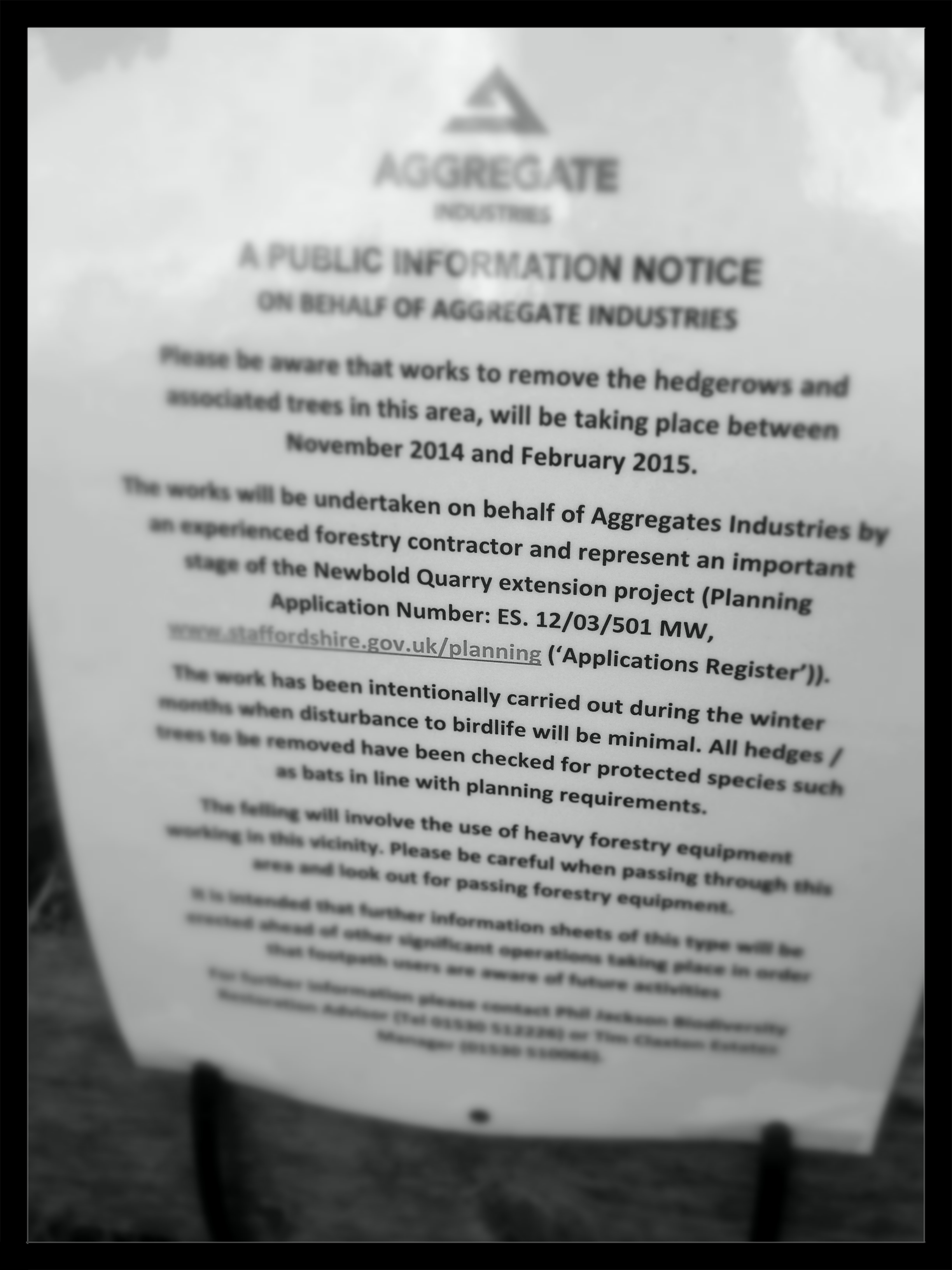
They told us it was going to happen. They put up posters. We can’t complain. We were given fair notice. They were on display for two weeks.

Yeah. In Alpha Centauri.

“A fine dewy morning”

A chill morning, the sparkling dew emphasising the intricacies of the spiders webs and leafless foliage. A fug of watery fog, low lying, birds sitting motionless as if under fright but then almost silently, rising as one and letting off songs of joy as though the joys of Summer remain above the cloud.  It reminded me of an old song:

Oh the lark in the morning she rises from her nest
And she mounts in the air with the dew on her breast
And like the pretty ploughboy she’ll whistle and sing
And at night she will return to her own nest again

IMG_2476_fotor

Early autumn jottings

September 2nd
An early start to Herefordshire, and the first sense that Summer ebbs as Autumn flows. From the broad valley with the Cotswolds on one side, and the Malverns the other, the M50 is the apple route. It becomes immediately more rural, and grassy. Rather than illuminated signs telling you to “use hard shoulder when busy” here they just say “Soft Verges”, a polite warning not to break down as the hedgerows will swallow you up. Then, outside Ledbury, the apple trees begin, defiant, proud, spiky despite huge stands that map the rolling lie of the land. They are heavy with fruit.

September 11th
With a strange circularity today, I meet an old colleague Giles. He worked for an advertising agency in Edinburgh who my old company used, and in 2001, we were up in the Scottish capital in a ‘pre production’ meeting, a critical stage in making an advert where everything about the forthcoming shoot gets agreed. During the meeting we heard the whispers. ‘Have you heard what’s going on in New York?’. Diverting the focus of the meeting, we watched transfixed. When the towers fell, it was impossible to comprehend what was going on. The setting was so familiar, so much like a movie set, watching it felt like one. But it was only in the taxi on the way to the airport and the flight home, that what had happened sunk in. We flew home.

IMG_2337The Plane trees in London are beginning to hunker down in preparation for winter. Leaf edges are curling up and turning cello brown. Some fall early; walking between parallel rows, the gravity of expectation is almost palpable. I don’t know why Planes are so named; but I have a soft spot for their versatility and constitution. Their fruit hanging like posh Christmas decorations, bulbous, glittering and furry; unlike conkers they don’t seem to fall. The Planes have adapted to thrive, like urban foxes.

I wait for my train at the British Library. To work at the library café it seems you must have an Apple computer, but they seem to sell very few apples at the counter, only cakes and excessively crusty sandwiches. It is though, to paraphrase ‘the restoration man’, George Clarke, ‘a great space’ and time passes quickly.

September 14th
I ride 62 miles on my bike, but feel unwell throughout. The land however is bursting with health and vibrancy. Climbing over the Chase under trees, I glance up at the canopies overhead. With the strong light behind, the canopies form patterns like fancy pants wallpaper, Laura Ashley, Farrow & Ball.

September 23rd
With the passing of the Autumn Equinox the daily stride towards darkness begins. And so too the bustle of Autumn, everywhere activity. As the sap in the tree falls as the days shorten, so the wind can starts its ironic late Spring clean, loosening the leaves’ attachment to their home.

The light lingers long now, backlit, iridescent. A short walk against brooding dark skies sees the hills lit up with spotlights. Greens are greener; the autumn colours commence, duns, browns, burgundies, reds. And the puffs of falling leaves have started. The horse chestnuts are letting go all around, a leafy mulch on the pavements. Other are less forthcoming, the oaks are still green, the little coins of the beech are preparing.

September 30th
This morning, low mist hangs over the fields and in places hill tops jut through, floating on the clouds. The sun is low. Bright reflections and long shadows of a leggy man striding across the fields. Squinting. And in the distance a swan, wing up, preens, preparing to hunker down.

The rook’s nest

There’s an ash tree in a corner of our land, a youth really, strident teenager, all lanky growth and fecund fertility. It throws off its keys with profuse thoughtlessness; blocking gutters, fertling their way into preposterously tight spots – lodging tenaciously underneath car windscreen wipers, tightly wedging themselves into window seals and muscling into the etched grips in shoe soles. Yet already, thoughts of chalara fraxinea are a shadow on the horizon just as it on so many blackened stands of this tree: will it find its way to our ash, separated as it is from its breathren or will it manage to keep its head down despite the fact it is reaching ever higher?

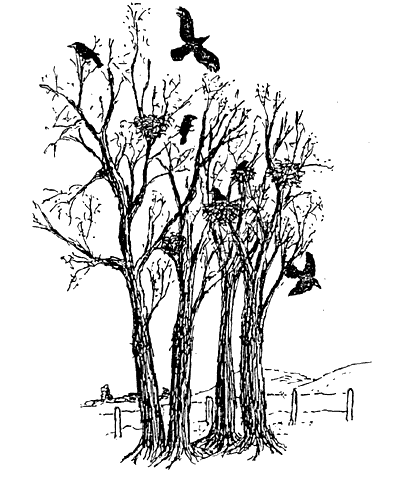
Certainly the jackdaws will miss it if it goes, the crows too. The jackdaws love Autumn, throwing themselves from the tree into the wind’s blustery vortexes, arcing and laughing as they do, sweeping up and round, wings outspread and curving; an air-fuelled dance with the breeze. The crows look on disdainfully, legs outspread along the fence top, braced, with their chokking caws, guttural, coughing. They would take to speaking Flemish with ease. The rooks though are above it all, aloof and aloft. A small family resident in the ash tree, probably moving into an old nest and then extending it, ignoring the planning laws, The Local Plan and Conservation Officer to boot. The nest certainly looked big from below, we would gaze up watching it grow, the rooks with their straight white beaks and glossy domed heads looking down on us, waiting for us to go.

Then tragedy. Violent wind, making the ash keys dance into the air like the crotchets and triplets of a musical melody line penned by nature, levered the nest out too: a finale to the score; the base drum, booming to earth. It landed in the night, the reverberations still felt the next day as the baleful drawn out cries of the rooks had vanished. With their home fallen, they moved on, seemingly without sentiment, their rebuilding must commence, this time elsewhere.

Screen Shot 2014-10-04 at 08.13.01
Image: courtesy http://www.wildlife-sound.org

For us the legacy was their nest; a prickly-edged oval, close on a metre long, two-thirds across, half deep; its scale up close shocked me. Like most of us, I had only ever seen the nests from afar, a jerky outline of a mess of sticks in a far off tree in a naked winter tree. But this was no jerrybuilt affair – they consulted Building Control after all. Tightly inter-woven with long flexible pieces of ash and dogwood, stripped of leaves and with strengthening braces running down, it was padded out with tufts of moss and wiry dried grass. Not neat and crisp like a wicker basket, but pliant and strong all the same. The wind that dislodged it had been ferocious: it needed to be to upend this home.

Now, the ash is home to woodpigeons and a new chorus has begun, the soft breathy woo and coo; the backing singers have stepped into the limelight it seems. Yet, just this last week, I chanced I saw a gothic feathery outline bouncily balancing in a neighbouring willow, a white beak, flashing like an epée this way, then that. Perhaps the rooks’ housing cycle is starting again.

Valley

The AA Guide to the British Countryside is now out of print. It was a hefty volume; thick spined and well thumbed; a reference book, not a book for carrying in your knapsack as you yomped down shadowed green lanes or across fields towards a distant stile. Yet it celebrated grand attractions and intimate views: from an old tree topped hill fort scarce noticed, to field patterns, to towns, cities or magnificent vistas; it celebrated special places up and down our isles and made places feel special in turn. It was designed no doubt, for long nights poring through its pages, planning roads trips; in reality it was a homage, suffused with a sense of place born of countless years of nature and man weaving their patterns on the land.

One of the glories of the guide was shining a light on the uncelebrated. One such uncelebrated place was the Blithe valley; a short stream, rising east of the Potteries and heading east again and south before joining the Trent. The name is thought to be Old English from gentle, which is perfectly apt; it is only a small river, which meanders lazily and somnolently through its willow lined valley, wet meadows and hedgerow still persist . The Guide, rather understatedly, described it as “the quintessential English country scene”.

It was mistaken though: the quintessential English scene is next door;  the next stream draining into the Trent watershed heading east, the Swarbourne, is more hidden, and quite different in character but equally everyday, equally unnoteworthy, so much so that like the many scenes like this, we take it for granted. The Swarbourn is a river of only 10 miles from source to confluence. Rising in the ancient Needwood Forest, unlike most streams, its valley is tightly bound through both its upper and middle reaches; it has more purpose, directness, yet remains humble.

John W_fotor

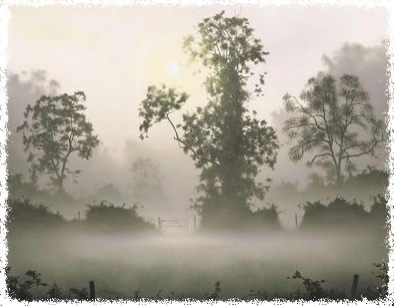
The source is a hidden spring amongst trees and leaf litter. Its foot, where it quietly merges with the Trent, you would hardly notice: there is a water meadow, bowing grasses and stately, tall reeds and then it is gone; only the Swans, surfing the short rapids here notice its influence. Between is the valley. Whilst it is narrow and steep sided it is not soaring. Cloaked with rich and varied woodlands in a patena of greens and browns; narrow paths snaking up through dappled shade, the verticality is emphasised, but it is a show. Lower down, the floor of the valley leads the eye on to a close perspective, shortening distance with softening trees and sharpened at its edges by unruly hedgerows of hawthorn and beech, reaching out into the road, brushing legs. Oaks, sporadically planted in the hedge, mark boundaries, overlooked corners, intimate meeting places. The river is never far away. Bridges here are simple affairs and now more beautiful because of it; low walled, flaking brick and stone; the arches unseen, easily filled by rising flow.  Fords are common too, with rutted lanes bouncing down to the rippling, running water, faster flowing over the drift-line.

In places the valley opens up just a little; but here the views explode out: a distant Church tower, a stand of brooding Scots Pine waiting to be climbed, a whale-backed field with the slow shifting spots of black & white cows; nearer to is an old cornmill, with apple trees dangling long arms over a speckled green pond, before squeezing in again, cramming the landscape back into a postcard window. The valley is its own world; longitudinal, like stops on the line.

(Image: copyright, John Waterhouse; www.johnwaterhouseartist.co.uk)

Apple hop day

Over the holiday I read Wildwood by Roger Deakin. It is his quiet celebration of a life spent with trees; learning their ways, being amongst them; using their fruit, and in their second life, their timber, their tinder. What is striking is not just how different one species of tree is from the next, but how each tree is an individual: its burrs, its knots, its shape, its bifurcations; down to the separate world that lives deep within the folds and knurls of the bark itself; each in a way as a separate from one another as our cities; distinct but unique, able to communicate, an interdependency of richness. It is both an uplifting read and a soul-stirring one. As the story of our lost ancient woodland unfurls, as the realization of how much has fallen under man’s saw, then it takes on a haunting, elegiac quality; not in morose prose but in accenting the profoundness of our loss.

This week I was uplifted by trees though. Driving through the weaving, wandering, looping lanes of Herefordshire, one minute I would be surprised by the forceful push of large lorry wafting along a road built for carts, the next confronted by a green verge running along the road’s centre, high banked hedges and overtopping trees, their outermost leaves gently dangling and waving above your head. I had forgotten how that land is defined by short, steep hills, fields that pitch and flow into the distance and stands of ancient trees; uneven in height as the eye pans across them; uneven too in shape, colour, form. Trunks of brown; deep greens and grey; and, even at the start of Autumn, abundantly, vigourously plump with life, sap, fruity vitality.

Just outside Ledbury, heading west, is apple tree land. The trees follow the natural contours of the land, planted years ago in immeasurable stands forming today’s superficially boundless orchards. The apple seems a proud tree, rounded in form yet spiky close to; planted en mass yet independent, shapely, interesting to the eye. This year, apparently, has been a bad year for wasps and a good year for fruit. So it seems; trees lining the roads hang saggily under the weight of a large and ebullient crop; dessert apple in size; preening themselves with red-robin bellies to the sun. Earlier I had drunk some farm-pressed apple juice; it was rich, fat and delicious; now I looked forward to the fermented version from these same apples.

Later that evening, I inspected my hops. They’re ornamental not for brewing, but they snake and bind pleasingly through a corner of my garden; bullying some plants, clinging on to others, finding holes in my fence where knots have fallen out, and pushing through, looking for the sun. The cones are just passing their best but are still lime green and resinous, almost to the point of dripping their oils. Some I will dry; others I will put in the house for the aromas; most will be cut back in waiting for next year’s hop shoots and riotous cycle of growth.

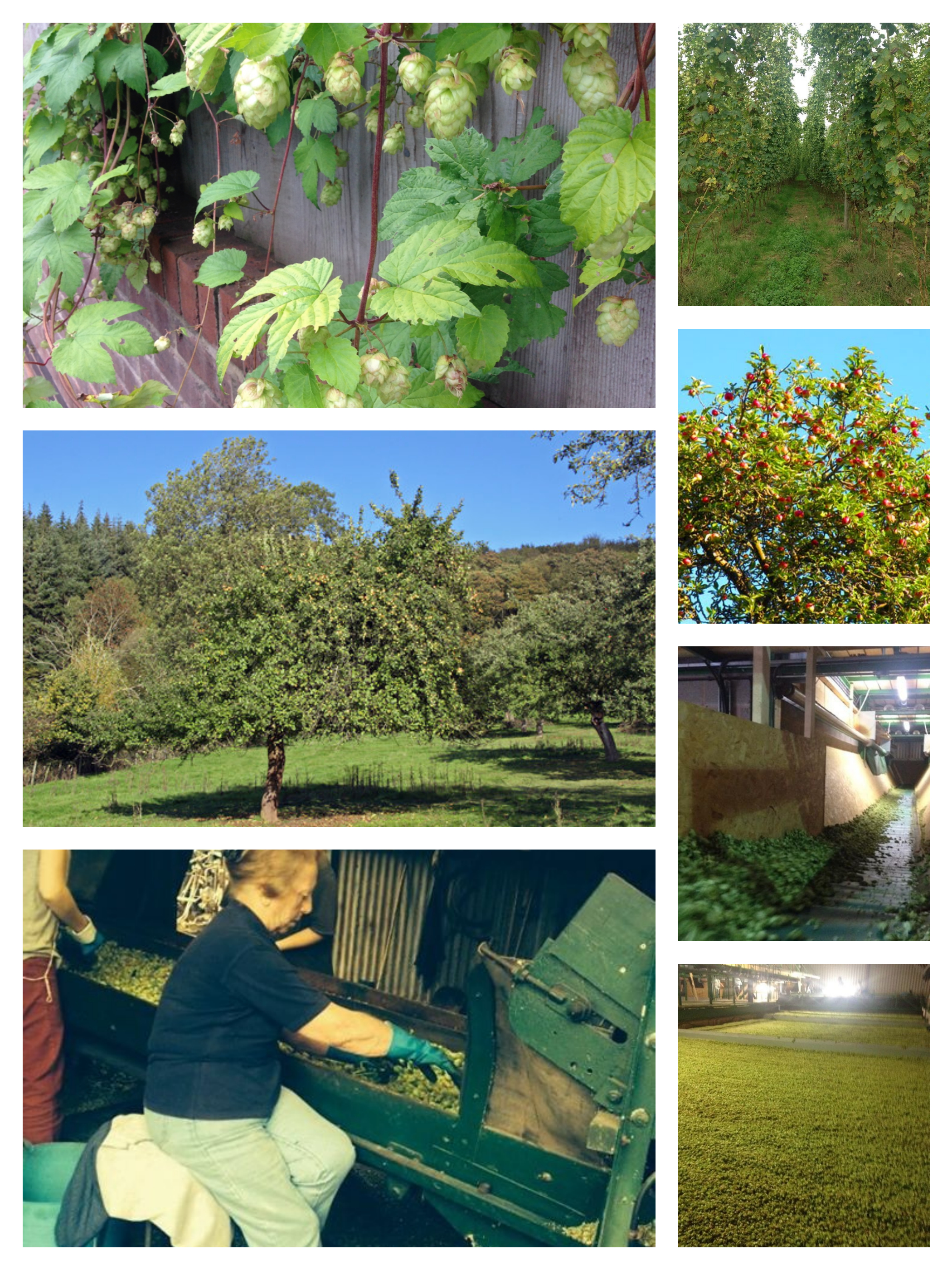
The apple-hop connection was only made later when a former colleague, Jo, posted some pictures of a Ledbury hop farm onto facebook. She had been to the farm the same day as I had been gazing on the apples and to watch their harvest; the bines twelve to eighteen foot; broad leaves like maples and dark, fleshy cones in bunches like a prize fighters fist. Most cones are stripped from the bines on a heath robinson contraption that cycles a hook round and round at head height; the bines dangle like a freshly butchered carcass before being sifted and sorted by hand and laid out like a thick pile carpet to dry. Like the fat apples, they spoke of spicy, citrusy, earthy beers to come; I licked my lips in anticipation.

For many, and for many a long year for me, cider and beer are like cats and dogs: you are a ‘beer man’ or a ‘cider man’; the fruit or the grain; the press or the boil. But nature doesn’t see it that way. In this thick tilled soil, on those rolling hills, both are at home; growing, ripening with the passing of the sun; blossoming richly in time for harvest and to sustain us all.

Also posted on www.beertintedspectacles.com 

Apple Tree in fruit_fotor

Why do seagulls fly inland?

There’s a sinuous line of gravel pits shadowing the River Trent all along its confluence from the Dove in the north, to the Tame further south. They’re a two edged sword; on the one hand, an obvious physical blight, deep scars left from the ripping and destruction of diggers, tippers and tractors big enough to have come from a Transformers set. Meadows and farmland are gone overnight once they start; ancient trees, gnarled, cracked, characterful, part of your expectation of the landscape, levered out and shipped away. On the other, they prevent insidious urban creep and in turn create a new landscape, new habitats, and new life. Out of the flames a Phoenix rises, but in a different form.

The pits become lakes and find ingenious uses. From water ski centres, to nature reserves, to inland marinas with retail parks, short cuts joining them to the waterways, a honey pot of narrow boats. Others are left barren, hidden behind a stack of old shipping containers here or old army vehicles there. Some lie waiting for the grand promise of being the heart of a new village to be fulfilled.

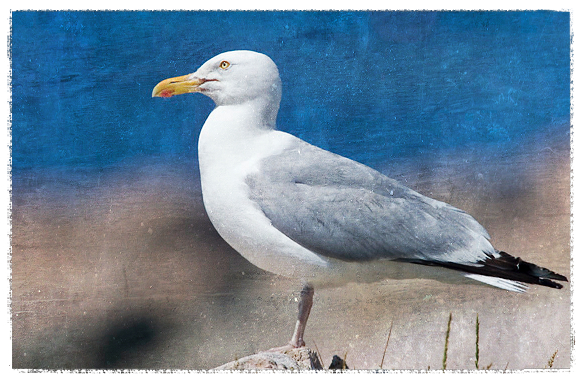
There are many newcomers once the gravel lakes are formed: tree species I associate with dunelands, pines, young beech; and grasses, tufty and spiky underfoot. Swans move from a few families on the river to banks of them on the lakes; same too with Canada Geese. And everywhere there are seagulls, here, as far as it is possible to get from the coast in this island. Flocks of them land on the lakes and rise as one, like dust swirls stirred up in a desert; in the air, they hang, feathering their trim to become almost motionless before dropping in graceful arcs. Sometimes, but rarely, they give off their crying, coughing, bark but never with the abandon they do at the coast. These are Herring Gulls: with their cranberry legs and soft grey wings, but there are no herring here.

Screen Shot 2014-08-29 at 18_fotorMy daughter and I debated why they fly inland as we walked around the lip of one of the lakes. The gulls were showing off; swooping strongly, pulling out; shocking the moorhens. Perhaps there is an inland roost; a safer home for them to rear their chicks – but they’re with us all year round it seems, so it’s only a partial explanation, and probably fewer foxes near the sea. The weather was put forward too, moving ahead of incoming fronts, sensing the air, staying dry. But these are seagulls, as adept on the water as they are in the air: capable pilots, seamen and fell walkers. So why not food? Just as a feisty Gull who fixed me with a steely stare tried to steal my pasty one warm day at Mevagissey, why not gulls checking through the Kebab waste outside Spiceland, or for shards of chip shop detritus, batter bits or half crushed chips, they’re innards gently squeezing out onto the pavement, part crushed underfoot? Searching for the chips to go with their beer-battered herring.

Roadkill

August, 2012

Just the other week, I had a genuine shock, one of those stop you dead moments (if you are a person of a certain age at least): my youngest informed me that Blue Peter had finished. Blue Peter. Most notable perhaps for the combustible Advent Crown and early product placement in the form of the use of industrial quantities of double sided sticky tape (why could you never get it in Woolies?). I however, remember it for the tits. And starlings, and blackbirds and maybe, just maybe, a cuckoo. Every year, Blue Peter, in conjunction with the RSPB ran a bird count. The idea was that you’d throw ‘Supersize Me’ quantities of nuts and seeds on to your lawn then over the course of the whole weekend count all the birds. We used to squat in semi darkness in my Mum and Dad’s bedroom, binoculars to hand, peeking through a gap in the curtains so as not to frighten the wretched things, and work on a rota system, roping in all wings of the clan. We were highly democratic: there was no pecking order. Anyway, as it turns out, Blue Peter is now on the C Beebies channel. We can all sleep calmly in our beds.

Blasted sparrows. That’s my main memory. Small and dull, with a touch of brown on their brown bodies, set off by their brown beak and brown eyes. And they were fast movers with a pugnacity which meant they didn’t brook any nonsense from their winged brethren, no matter the size of adversary. They were like flocks of dwarf bouncers orchestrating the other birds around the feeding zone to their will. Or rather, to their quantity: no birds dared mess with the sparrows, because force of numbers alone meant they wouldn’t win. Sparrows ruled. End of.

Not today. Today you’ll be lucky if you spot a sparrow in your garden. The rise in the number of house cats is typically cited. I’m not so sure: admittedly, I’m not that attuned to cats but there don’t seem to be demonstrably more or less than a few years ago. And I don’t remember the last time I saw a moggy wandering around with a clutch of sparrows hanging from its jaws, ready to barbecue or enjoyed as a carpaccio.

Link this if you will to the game of ‘beer can market share’. This highly entertaining game is best played from a push bike. Essentially, as you ride along, simply count up the number and type of beer cans in the verge; keep a mental note and then convert to a rough market share at the end of the ride. Stella Artois, Carling and Fosters seem to be the main winners, unsurprisingly, with pockets of San Miguel or Kronenbourg, generally in more urban areas, and more surprisingly, Carlsberg Special Brew which no longer seems to be the ‘on street drinkers’ beverage of choice, yet remains popular, verge-side. Recently though, I have converted this game to that of Roadkill Counting. This isn’t some sick festish. It’s just come into my consciousness: there simply seems to be more dead animals in the road.   In a car you wouldn’t notice – let’s be honest, the animal is probably smoking the radiator as you hum along to Elbow and the kids in the back are distracting you from the badger you’ve just taken out.

And here’s cause of the sparrow decline. Pigeons. These are the new barrow boys of the bird world. Wheeler dealing for some knock off Trill and ganging up on the jackdaws for pecking rights in the manor. I know this. I know this due to the roadkill count. Pigeons are right up there you see, and truth be told it’s quite sad. For the artless pigeon doesn’t take death in its stride. No, the hapless things are generally lying, splayed in the road with a look of abject bemusement and surprise, rather like Arthur Dent reacting to the Vogons arrival on Earth.  And their wings seem to take on statuesque shape and proportion. One, just last week had managed to land on the road, pecking for some titbit I suspect, just at the moment a Landie came along with its rather thin wheels and took it out in a graceful body shot. Rigamortis quickly set in, leaving the bird’s wings protruding up in the air, as if ready for take-off with its body level with the road. Thor’s helmet came to mind.

Slide1_fotorBut there are no sparrows. There are badgers; hedgehogs (many); the occasional fox, pheasants of course (they’re the jumbo jets of the avian world – long slow take off. Alas, their flightpath is too often across a busy carriageway) and even birds of prey (mid swoop take out?). But no, the answer to the decline of the sparrow is this: pigeon eats sparrow; car eats pigeon.

Steeple

A distant relative, an uncle at least once removed but more distant in terms of the knowing of him, I am aware of through story and hand-me-down snippets of information. Walter by name, a north countryman and bon viveur (some would say, a swanker) in life, lung cancer by death, steeple jack by trade. One story runs that to scare an ageing aunt he performed a hand stand on the blue clay ridge line of a 1930s terrace just off Canal Street.  I’ve heard tell that it was one handed. Embellished with time perhaps: but in essence, the lines of his saga weave consistently. A talented, braggish bloke, choppsy too; a showman, a great smoker, and at heart, a good man.  What’s certain is that he had a head for heights. Travelling around east Cheshire and south Lancashire repointing and repairing mill chimneys, brick and metal banded typically, 100, 200 foot high. Domestic work for cash, and for favours or back handers fixing up buildings with wind vanes and weathercocks. Once or twice he topped out church steeples – most often with lightning rods, less often with a Cross for light of a more divine nature.

IMG_2072_fotor50 odd miles away, today I live in the borderlands of Staffordshire and south Derbyshire, where the Trent, Tame, Mease and Swarbourne course across their flat, cobbled, gravelly confluence, snaking and splitting, the river banks edged with willow and ash; swans, wings arched back, hissing and spitting. Gravel pits shadow the river hereabouts where perhaps there should be levees, but as yet, no one has built on the flood plain so nature can feed the fields. Over the bailey bridge, tucking in your ears and edging gingerly, the ‘Derbyshire side’ of the river – actually a confusing hinterland where four counties intertwine – rises sharply as the valley cliff rises; the land has been heavily deforested, yet high hedged fields are verdant and rolling all the same. Occasionally an ancient tree stands sentinel in the middle, alone, proud. The villages are close-set and alliterative: Edingale and Elford, Haunton, Harlaston, Huddlesford. Their steeples too, rise sentinel – cleared of large stands of trees to block the view, they soar vertiginously, like poplars. At the bend in the road, the spire of Coton in the Elms stands out on a hilltop; from there, that of Lullington, hidden by yews close to, stands out clear, naked, beckoning; and from there, Clifton Campville, with its delicate spire of stone calls the eye like a comet with an earth coloured tail of mosses, liverworts and lichens.

Further north, the salty wind of the Irish sea blatters up Ennerdale, whipping the stands of conifers; their canopy swaying in unison like arms aloft as the ballad is sung. The fells rise quickly and rough here, drawing in tight, probing, pushing into the very heart of the mountains. The summits are on the bagging list: Scoat Fell, Pillar, Red Pike. One, cramped by its neighbour, is famous all the same; linked as it is by a stony and loose razor ridge, a gravelly, slippy arête, before a short, sharp clamber to a pyramid top: a mountain scribble on a beer mat. A child’s mountain. A mini Matterhorn, a Steeple of rock and scree.

Just the place, then, for a one handed hand stand.

Green Lanes

It is said that man makes paths; marks in the earth that pass through the ages.  For me, the opposite is true. The paths make marks on man; lines, etched in earth and etched in memory. Trod in, stamped through. Lasting through life.

One. The green lane to Tall Chimneys. Cuts down from the main road; high hedges of hawthorn, hollin and beech, bowl out, beer paunched. The road arcs down the valley side, descending into perspective, the hedges narrow it further. The lane, stony at first, rim-rutted and hobnail trod, becomes rougher still; and as it sesses down the shadow dappled bank, clinging on, it is more worn, escaping grit and cobbles slide away under foot, hissing and skipping away towards the brook. The verges, thin and feather-edged, soak up feet marks like moss or putty or ebb-washed beach; pliant, moist. At the breach where the pitch steepens, the green lane has cut through; not the cut of a knife or a digger trough, but of feet, of soles. Working boots, cussed and torn; northern clogs clontering & sparking on old river cobbles, long white scratches; Sunday School best, moving lithely to and fro, avoiding the holes where the skin of the lane has rubbed free. Trees overhanging, branch and leaf locked together like a children’s party game: elder and buller, rowan and hazelnut, fingers intertwined.   For the Horse Chestnuts they come, roots like flying buttresses propping up the steep soil sides; a mangrove in temperate loam.  A rope swing over the water; conkers like Morning Stars, or comets, with flying tails in the night.

Then. The green lane at Timbersbrook. The roads round The Cloud follow contours, from above, rings of ever decreasing horseshoes. Not the green lane; clambering straight up joining one road to another: a shortcut for people long forgotten, stopping before the steep face where we used to boulder. Lichen shod, mortar-free stone walls of uneven shards of black-flecked gritstone, furry with moss, topped by beech & ash. The lane, not green but grey, rutted, rocky, a river bed made by man. We drove up; wheels bouncing and skidding; tyres pinging with air-taught melody, the steering wheel turning unrestrained, bruising fingers, snapping at thumbs. My forehead, a damp coldness of fear. This was not my car.

Two of the green lanes in my head.

Green lane_fotor