There she is again; the voice, dulcet, soft
half-sung, semi-distant
audible, but faint; clear, yet indistinguishable
a whisper to me, gently, skin to skin
lip to ear, touching
a caress, sonic, wave forms that reach out, unseen
and come to shore with the riffle
of brine water over beach stone
or morning breeze through beech leaves
an echo, of past lives and what will become
Category: Life
Loss
A glimpse of a field-track; bounded by stone wall and mottled rust brown wire, holding back the drooping heads of wheat, arches gently over a whale-back hill. Footsteps and hoof marks mingle, intertwining snakes of knobbled bike-tyre tracks, cut nano-breakers in the mud. They take me back to you.
A pint in hand, hazy white through endless chinking, rubbing shoulders on a rinse-cycle, yet the chestnut brown beneath shines through still; the cumulus head floating above. It is raised slowly and takes me back to you.
A tray of pies, bask on a greaseproof towel. Like sunbathers under a midday sun, they brown and sizzle gently. Deep walled, their eggy wash is a sparkling sheen, factor 20. A perspiration of gravy bubbles up from below the lid. A man buys one, wrapping the bag around the body, he decapitates the tourist with carnal zeal. It takes me back to you.
Kayakers on the river, bob like cygnets or inconsequential ducklings, following their mother. The languid rotation of arm and blade, like a goose stretching its wings before flight, leaves saucer marks in the water, drifting away. They take me back to you.
The tired eyes, holding back sleep from the warmth of exertion; yet a smile creases the corners, the mouth too, recalling a moment; or a joke; the fuel of conversation. It takes me back to you.
A long line
It’s a short 50 miles from where I live now to where I grew up. In truth, I’ve lived round here longer now, plus a sojourn down in the West Country to study, yet for all this, my roots call me. The 50 miles is defining. For one, it crosses a regional divide, somewhere along the D road and near the motorway junction. And things do change: here, the bricks are flaky and soft, efflorescence puthers from the faces. But back home, they’re darker, harder, with swirling blue mottles; pointed differently too – flatter, narrower. There’s more stone too; particularly round foundations, whereas my house stands on 3 stretchers and some firm clay. “It hasn’t fallen down yet though” a structural engineer semi-reassured me before we did some work here. The 50 miles is important for another reason too: for within its lengths are the marks in the land which I associate with my first years on earth. The narrow steeple that bisects the carriageway as you drive towards; Mow Cop, its folly and pyramidal flanks away on the horizon; the Common where the Scots were massacred in the ’45; to the smaller, more personal links: a spectacularly twisting lane where I used to cycle up and down; a knot of trees and thicket where I played with my friends.
I went back last week whilst my parents weren’t home; I was guest horticulturalist for the period they were away; well, I watered the plants at least and picked up the post from the mat. I took my dog with me; she likes it there – it’s her holiday home so she begins to cry and whimper excitedly as we turn off the motorway and closer, when we pull up the drive, she dances around the back of the car in her excitement to get out. Later on, I took her for a walk – as much for me as for her. For me, it’s a chance to reconnect; to see how things have changed both markedly and subtlely. There’s been plenty of both and it’s an odd sensation to feel: seeing change in a place associated with my family, with me, for generations but knowing that for the last 25 years or so, I’ve not been part of them.
So we walked; the dog with a spring in her step re-associating herself with smells, walls and posts; me keeping an eye out for a familiar face or snicket. In the main, the change – in appearance at least – has been for the better. The place seems smarter; on its uppers somehow, which, given the loss of all the industry here is no mean feat. We walked past the Town Hall, a Victorian building with bright Ruabon bricks tightly set and Gothic features – sharp-pointed arches; lancet windows with trefoils, ornate ironmongery, a steep-pitched roof, badges of civic pride. Before it was a town hall, it was a pub, my great-grandfather was the landlord. It was a Joules pub, from Stone, halfway to where I live now.
Growing up, my local was a magpie-built place down off the Cobbles. When I was a child my grand parents would lift my brother and me onto the old stone horse-block outside the pub, a relic from the days when it was an important coaching inn between Manchester and London. These days though, there’s no passing trade, so the owners have tried to make it a destination in its own right, a ‘craft beer bar’, run by a new incarnation of Joules Brewery (reborn in Market Drayton).
I could feel the echoes of my fore fathers. Nearby, in a rebuilt building my grandfather was born and just further on, there’s an old fishing pond which he played and later, I did too. There are more buildings today down there now which surprised me; it used to be a bit claggy and midge-ridden because the river flowing in to the pool didn’t match the narrower cut flowing out. But that’s been sorted and rather than the old forge, there are town houses, mostly in keeping; some not; but it was good to feel the new life breathed in all the same. When I was young my grandfather used to walk us along a half-gravel path that ran alongside the pond where some horses grazed. My grandfather was a motor man – the first generation to embrace the internal combustion engine; but he still grew up with horses, and working ones at that, and he treasured them all his life. We would feed them grass and try and get them to bear their teeth by letting them crunch on Polo Mints.
The horses are gone now, but the old cottages opposite are still there, banked in against a hill. My dog became fretful and started to pull me towards an old set of steps up to one of the cottages. Lovely things; they are built the wrong way round; the treaders are cuts of local gritstone, deep grey, almost laminated; the supports they sat on are old bricks, long and shallow; thickly pointed; explosions of thick grass swards sprang out from the base. She sniffed; I remembered. We used to wait here while my granddad chatted to the owner, a long-distant acquaintance. The conversation was one of those long on memory short on words; not much needed to be said that hadn’t been said before. It was a checking in; deep chuckling about the state of things. Later I learnt that the gentleman was actually a relation somehow, part of the long line, a line now unconnected in all but memory and by the marks on the land which stay constant to us, wearing slowly.
My daughter played on her grandma’s iPhone, a cameo of how life is today, indignantly bemoaning the fact that she had a ‘lower version’. But then she stumbled on a genealogy app, and within 30 minutes had plotted back three generations on four wings of her family. And there on the screen in front of me was a short picture of the long line. My grandmother, born on Mow Cop; her parents born up in the foothills of the Pennines; marrying my grandfather born in an old magpie cottage down near the horse paddock and old fishing pond. In this virtual world it all became more real somehow.
Up at the northern end of my 50 mile journey, Radio 4 can’t decide which signal it prefers. I switched between two to hear a debate about whether Neanderthal man and Homo Sapiens were individual species. Typically, it reported, we have 2 – 3% Neanderthal DNA in our genes. In Austria, ancient remains of a man uncovered that he had 9% – a startling amount, higher by far than anyone ever found previously. Either way, the presenter argued, there was clearly no way that the two branches of humanity could be treated as separate species as, what marks one species out from another, is that they cannot breed. For me; it was a point I had learned in theory becoming personal, landing true. As the dog and I walked we found markers of my long line; the stone steps; the paddock; the pub-cum-town hall, Mow Cop on the horizon, connected by memories of our people. But we were only tugging on the very tip of the line, a line which ultimately goes back to footmarks set in stone in a distant Rift Valley and truly, further than even that.
The greenhouse
A few years back, I regularly flew to Amsterdam. From the Midlands there are two routes; from Birmingham, the planes track a thin scar, a line of running stitch above the M1, the M25, to the reflective meanders of the lower Thames estuary; or, from the East Midlands, heading out east, over first the Wash then the Waveney and down the Suffolk Coast, the glinting wind farms hover like mayfly above the surface of North Sea. Even from up high, you can see the silvery wakes of fishing boats. The glasshouses in the Fens glimmer and sparkle from up there too, more so as you descend down over the lowland, dune-ridden coast of Zuid Holland, over Zandvoord, Haarlem and Hoofddorp – there’s a stretch, just inland where the knobbly, tussocky grass gives way to endless glass. And my mind would always be filled with images of off-red under ripe winter Tomatoes, slightly grainy, crunchy even, courtesy of the assiduous Dutch.
Round here is much more mixed. Rolling land, fertile soils, here clay with beautiful cobbles where the land was once river, there dark loam, thick with centuries of leaf mould and ancestries of worms. About now we have swathes of oil seed rape, bright and pungent, but also stands of wheat that ripple in the breeze languorously, and dairy too – we’re not in the Netherlands, but you wouldn’t know it from the immigrant Friesians that plod and chew through these pastures. And despite ever more land given over to the floating trays of hydroponic strawberries, it’s definitely not greenhouse country. Most round here are like the one down on the village sports club. A semicircular structure, taught plastic film, not glass, that vibrates and buzzes when the wind blows just so, cost effectively constructed, hidden away in a corner. That greenhouse has yellowed with age, been patched or left, long grass grown around its feet like sock elastic gone limp. I assumed it was unused, unloved. Any radishes or carrots emerging from here would be leggy and odd shaped, surely?
 But as I cut through the nettled footpath that brushes alongside it the other day, there were muffled grunts, chorused rumbles of gruff bass-voiced men and sudden sparks of shouting. A crime? A bizarre initiation? Stranger, a little further on there is a jerry-rigged frame of scaffold, wire and rope. I’d often wondered what it was – not industrial enough for an oil drill, too old for the frackers. Now, there was a thickly twined rope straining at a shabby concrete weight, lumps taken from the edges like a conglomerate loving dachshund.
The greenhouse in fact is nothing of the sort: it turns out that it is a rain cover. Underneath, a team of men, straining on a rope. “Keep it low” “Hold and heeeeave!”, pulling, lifting the weight, smoothly, in lengths of well-drilled backward stride. Here, in a curious circularity is the home of the coincidentally named Holland Tug of War Club. And this rather tatty greenhouse in the corner of a field is the training patch of the UK Outdoor Champions, not the vegetable patch of beetroot or lettuce.
It snows cherry blossom
There’s an ash tree in our garden
An adolescent, flushed with attitude of youth
It shoots out and shoots up
Not needles but keys, that dangle lank
Copious and voluminous, like a fertile vine
Come Autumn, when the wind whips and swirls
The air fills with the parachuting medals of
Maple and sycamore, spiraling, twirling
Their Viennese waltz, dizzily round
The ash keys, are more direct, a tango perhaps
Keen, forthright, intense, they snap and fall
They fill the drains; block downspouts
Yet are pretty for it just the same
None though, lights me up as the way
Cherry Blossom illuminates the Spring
White, like icing flowers or a touch of silver mascara
On a smoky eye, it rises like dust, glinting in the early light
that spears down from above
and then settles slowly, like Spring snow
or my love’s caressing hand upon my knee
The grass between my toes
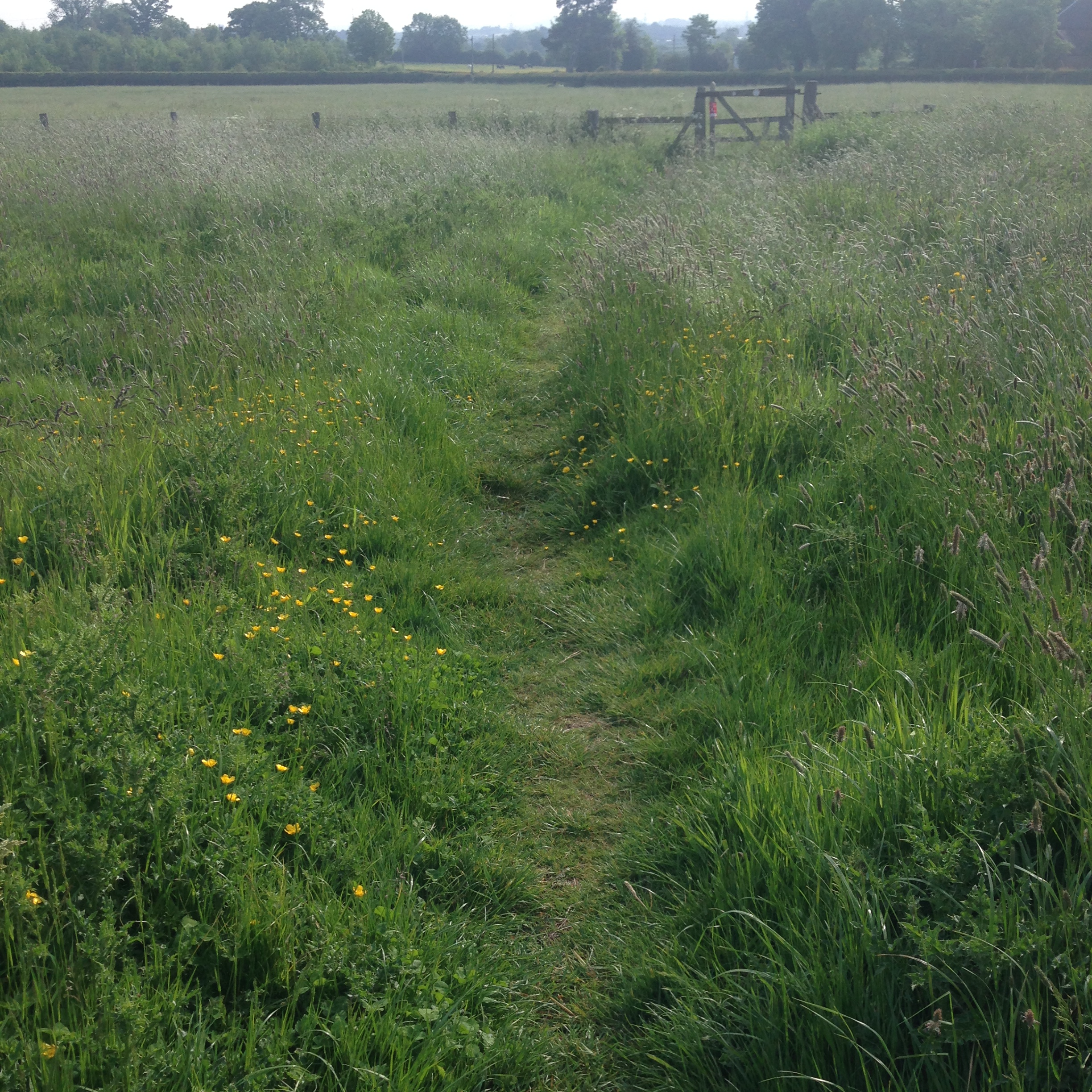
Today I stirred through the stone clad streets of our city
bear footed, thick soled, I padded
purposefully, confidently, cautiously, at times
but always feeling the ground beneath
the gravel, sharp and rootless, biting
and shifting underfoot
setts, crackle edged, deep-recessed, northern-rooted
smooth tarmac, warm, swarthy, vibrating gently
with an imminent car or bike
Hopping up a kerb, I scuttled into
a steeplechaser, bounding, leaping
my course the potholes or unseasonal puddles
But for all this I want to feel the grass
between my toes, it’s sword shard edges
breaking swards to release the smell
of first-cut lawns in Spring
a snaking path through oxeye daisies, buttercups
shining nettles best avoided are there all the same
spurring me on through that way
with the grass beneath my toes
Escargot Armageddon
The hosta, a North American native as I recall, thrives in our garden and I love them. Love them for the shapely, cup-handed leaves which gather the water, hold it and let it glisten in the light. Love them for the fecundity: the garden centre’s worse nightmare, a plant that doubles in volume each year, just split them and replant. Love them for their tolerance: light or shade, up they come, arms open to the world. I don’t know the varieties, but in our back door pots, we have a particularly lime green one, with variegated darker edges and a bright yellow hit of colour at the base on the inside. The hosta seems a perfect foil for us; on odd dark and gloomy Spring days, with broodingly malignant skies full of the potential of rain, they still shine as if powered by an inner luminescence.
In slug and snail world things are different. Whilst I may admire the architectural form, the stately leaves of the hosta, they look at them with a gourmand’s eye, only with out the critical faculties and food appreciation skills. Their cerebral cortex (I picture it as smaller and somewhat runnier than ours) lights up with synaptic chaos, like London viewed at night from the International Space Station “FOODFOODFOODFOOOOOODYUMYUMLETMEATIT” they yell, the blighters causing pandemonium. At first a scalloped edge; then a leaf chomped hungrily and before you know you weep into the curving dried brown stains of cold tea at the bottom of your cup as you survey the chewed stumps of your once prize blooms. Credit, it must be said, to the hostas for returning year after year.
But this would not do. It was time to take it to the mattresses. If need be, using a wretched mattress to camp out by the plants to catch the critters. To crush them. Destroy them. Smear them off the face of the earth. Without hurting them obviously. So the war starts in a phoney way. “We cannot harm the slugs. Let’s find a natural way of…moving them on”.

Thus it was that I entered the world of slug removal research*: scouring the internet; raking up the wisdom of nearby horticulturalists; divining for family folklore. The creatively chemical ways that Homo Sapiens has developed to wreak Limaxocide on slugs and snails are devilishly endless, and will not be transcribed here – although some I’m sure will soon be banned by the EU. More ‘natural’ ways included scattering shells or fine gravel around the plant base; putting a small saucer of vinegar or beer nearby; crumble up a brillo pad or sneakily concealing small snips of copper wire in the vicinity (that’s why the trains have been delayed, I knew it).
I tried a few. None worked. The slugs are simply too numerous and the snails remarkably persistent for a creature devoid of speed. Instead, I am switching tactics; moving the slugs on (into the brown recycling bin – let them help the local council’s composting effort) and the snails, well – they don’t know it yet, but I am considering a farm, and to let the food cycle complete a full rotation.
* Sung to the words of The Cult’s ‘Love Removal Machine’
Fleeting fossils
 The other evening we chatted about removing the fleecy jackets that cosset the delicate plants around our garden. In pots mainly, our fragile ones, prima donnas with slender leaf tips poking through, giggling, a royal wave. There’s a racy fatsia japonica in particular, who just has to stick her seven fingered limbs out from under her kimono, a shapely thigh revealed through a high-slitted skirt. But the threat of frost has not passed and Her Kimononess gets gently ushered back in. Good thing too; this morning we had a real nippy belter, with those interlocking palmate leaves of ice fronding together across our windscreen and a crackly hoar frost on the fence, sharp to touch, Christmas trees in miniature; and a stillness all around – the birds wise to warmth, the worms unable to break through, feeding time delayed.
The best morning for a walk these: the dog hares off, with no fear of a Blacker Shade of Dark and similar ditties, and the boots, well, the crunch. It may not be golden, but it certainly is delicious, cracking through frozen puddles, scuffling off the icy crowns on the grass with a deft side foot out to the left wing. Leaves hang lower under the weight of the ice and the white hawthorn blossom, which is coming out round here, shimmers mesmerically under its coat of cold. But the best of it all are the footprints. Down near the gate, in the lee of the rosehip hedge, cancer ridden with brambles, no light can get through and it’s properly cold there. It’s something of a crossroads that bit – one path snaking down off the hill through the holloway as I call it, another skirts around the spring line, bisecting it.
And there are the footprints, boot marks, frozen. It brings to mind the fossilised tracks in the Great Rift Valley. Last night’s imprints, frozen fleetingly by the first frost, captured in a freeze-frame instant before the rising sun oozes them into history. Maybe there’s a parallel world where they exist in stone and academics get frothy and excited, little knowing they were formed only last night. Or perhaps there’s a different way of experiencing time, in slow motion. In that world, we are in the grip of an ice age and strange footprints have been discovered in the permafrost, experts arguing about their origins. An imprint of peoples’ lives all the same, captured momentarily then lost.
The publicly secret goodbye
Over a low table, the accoutrements of a coffee ritual scattered hither and thither, they exchanged looks with penetrating yet gentle intent. He, a thin, long face, with thinning, long hair; she, olive-skinned, glossy, made up but dressed down. The train arrival announcements a far-off melody, faint, bouncing singingly, with the staccato intonation of a replica voice. They gazed at one another deeply, finger tips touching in a prayer-like arc. He glanced away, eyes fixed into the distance but unfocused. His thoughts remained at the table, whilst other tables were cleared. Her look; a faint smile spoke happiness. But his eyes betrayed something: love unrequited? Or sadness at their parting? His workbag, bulging, half closed and scuffed, showed the excuses he had made to his boss: he will be in later; he will be back for the afternoon meeting. Yet his behaviour said otherwise. No rush; considered movements; quick to think, slow to talk. Then their eyes welled up as she rose to leave. I looked away, momentarily lost in their unfolding story; abashed; ashamed to be observing such an intimate moment in such a public place.
First swards

The first green stripes have appeared, verdant and plump, fluffed up like new pillows from the fizzing barber’s blades; rotary cutters in a cycle of snipping. Clipped edges, scraggily neat, on turf in truth to wet to cut, but it’s a signal all the same, a beacon, that Spring beckons like the first rays of morning light, optimism rising. There’s always one who breaks the seal of Winter first, pitching for a place as gardener of the year, eager to see that thick-pile carpet of grass, moss and daisies, one light, one dark, feathery foot marks following where gumboots amble behind. The real change though is in the air not on the ground. Gone, the crackling dry smells of sharp frosts, cracking wood under sheaves of leaf litter and curling morning mists. In, the rich smells like snapped daffodil stalks, of grass swards, their winter hair army-sheared, their sap freed to storm dark adenoids and wake up the green man within.
 morningmistermagpie.com