
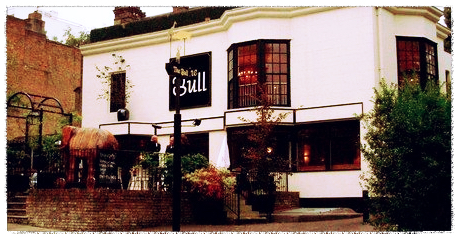
 On a low brick wall, drained pint pots hide behind plant pots & railings, lacing lines patternating their sides. Flagstones, flaked with wear and weakened by the dinks of a brewer’s barrel, show their many floors; millennia revealed in the journey to the door. A boot scraper, scissor-snicked Box and a heavy-hinged wooden door, smoked glass, the paint around the finger plate caressed away roughly by the pull and push of years of hands. Inside, tables made from butchers’ blocks, thick metal strapped, not true; beer mats and upturned scallop shells of ripped-open snack packets, their crown. Painted floorboards, black knots pushing back, point the path to the thick planked bar, the top stained, smooth as the handle of an old wooden shovel or yardbrush; care-worn, hand-me-down. Six beers nowadays; misshapen badges promising a kiss of hops, a play on words, or union with a local bee keeper. The menu, scratchily scraped onto a blackboard, sits below a dusty bine of once-green hops. The fire, made up, is even happier when lit. And the dog, a black lab, keen-eyed but languid-limbed, soft with endless caressing, warms your feet before moving on.
Category: Life
Low light
Early morning; it feels like I am heading east
But the low, back-lit winter sun scrambles over the horizon behind me
Sending lighthouse beams skimming over the grass
In a tree, slumbering pigeons blink to life
Chunky grey balls; camouflaged Christmas decorations
Dazzling flares of reflected light dazzle, hillbilly headlights
Mounted on ‘roo bars, off the panes of cheap double glazing
Chickens, loose in a field purr to life like an accelerating motorbike
Off in the distance

Post and rail
We exist in a human scale world, yet it’s a deception
For others, different worlds are there, different planes
A mortar bee, bat, a world behind bricks, their building blocks of life
To a spider, an eight-legged world walks little further than a post or rail
No Tesco trips, their food aloft it seems, comes to them


Winter Days, Summer Nights
Whilst I am not a fair weather biker, winter cycling does challenge. Inevitably, boisterous walks with our dog or short intense, mist-shrouded runs take their place, exacerbated by a busy pre Christmas business schedule. Yesterday though I fitted in a short ride: really, it was a late Autumn ride: with a bite to the air and the fallen leaves now a levée of pulped compost damming up behind the kerbstones like snow drifting against an exposed hedge or drystone wall. I wasn’t there, but my dad’s recount of the banks of snow up near Tegg’s Nose in 1956 came to mind, so vivid they were in the telling. Towards the road centre, the leafocaust was less intense, here a collage wallpaper print, the maples particularly picturesque. My tyres were skittish. Later I would buy some new ones to find more grip.
In the evening, I read some old blog posts, one from a now defunct blog I had called ‘The Speed of Bike’. The contrast in this post was immediate: in a few short weeks the clouds of insects, the warm smells of cropped fields and plump, rich hedgerow fruits, gone, replaced by the clear starkness and broad horizons of winter. It is reposted below.
I have a circuit. If Map My Ride can be trusted it’s 15.3 miles but close enough for me to call it 15 allowing for rounding. It’s mainly flat, but not so flat to allow just a cruise. The initial 4 miles are a long drag, more than a false flat, less than a ‘categorised climb’, with a lumpy road surface and regular ripples across the road which make for an uncomfortable hammering for the hands. Then a long section, 8 miles which is flat cruising on resurfaced roads, before a final 3 miles that loops me back into the village. It’s my unthinking route – if I want a quick ride and don’t feel inspired to route plan, or just haven’t got the time, then I set off, happy to be unthinking.
That was my mode last night. A quick gap before tea for a breather. Autopilot on, concentrating on the sensations of the road not the ride itself – it may sound strange, but sometimes there’s equal pleasure in just turning over the pedals. Pulling up not just pushing down; counting revolutions as the tyres gently whirr on the tarmac; feeling the road through your handlebars. There’s a mesmeric intensity to it which takes me to another place.
Last night though, Mother Nature caught me out. Not by a blazing show of power – lightning; hail, brimstone. Rather through the gentle elongated light of Summer. As I pedalled, I tried to think of the words for this piece – but unlike my pedal strokes they didn’t flow in the ‘there and now’. It was a bigger, more holistic impression of ‘this is what makes the British countryside so special’. And it was the light most of all. Even two hours before sun down, the light was low. It stretched everything: trees ran across the fields like the bony hands of a skeleton; buildings were pulled outwards like play dough, with a soft shadow added from photoshop. And the air was still warm, melting away in front of me as I cycled – just like the butter my gran would melt on the side of the stove before dragged her bone-handled palette knife through it for the first round of toast.
And the bugs. Millions of nameless, swirling, random insects pinging off my jacket, leaving small pok-marks as their exoskeleton performed its protective task. So many that at times I had to turn my head away and steer through eyes askance down the road. If there is a Maker and we are all to be judged then I’ll need to confess my sins for the number I unintentionally snuck up and spat out.
At last, home. As the brakes ease me to a standstill, and I clip out of the pedals, the sense of sadness that comes from riding on a long summer evening. Like the Summer evenings of our youth, there is just the lingering desire for it to carry on forever.
The rook’s nest
There’s an ash tree in a corner of our land, a youth really, strident teenager, all lanky growth and fecund fertility. It throws off its keys with profuse thoughtlessness; blocking gutters, fertling their way into preposterously tight spots – lodging tenaciously underneath car windscreen wipers, tightly wedging themselves into window seals and muscling into the etched grips in shoe soles. Yet already, thoughts of chalara fraxinea are a shadow on the horizon just as it on so many blackened stands of this tree: will it find its way to our ash, separated as it is from its breathren or will it manage to keep its head down despite the fact it is reaching ever higher?
Certainly the jackdaws will miss it if it goes, the crows too. The jackdaws love Autumn, throwing themselves from the tree into the wind’s blustery vortexes, arcing and laughing as they do, sweeping up and round, wings outspread and curving; an air-fuelled dance with the breeze. The crows look on disdainfully, legs outspread along the fence top, braced, with their chokking caws, guttural, coughing. They would take to speaking Flemish with ease. The rooks though are above it all, aloof and aloft. A small family resident in the ash tree, probably moving into an old nest and then extending it, ignoring the planning laws, The Local Plan and Conservation Officer to boot. The nest certainly looked big from below, we would gaze up watching it grow, the rooks with their straight white beaks and glossy domed heads looking down on us, waiting for us to go.
Then tragedy. Violent wind, making the ash keys dance into the air like the crotchets and triplets of a musical melody line penned by nature, levered the nest out too: a finale to the score; the base drum, booming to earth. It landed in the night, the reverberations still felt the next day as the baleful drawn out cries of the rooks had vanished. With their home fallen, they moved on, seemingly without sentiment, their rebuilding must commence, this time elsewhere.
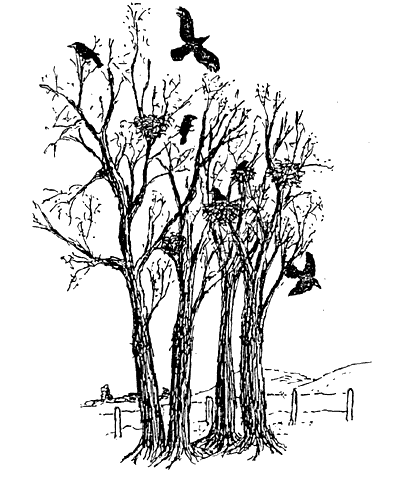
For us the legacy was their nest; a prickly-edged oval, close on a metre long, two-thirds across, half deep; its scale up close shocked me. Like most of us, I had only ever seen the nests from afar, a jerky outline of a mess of sticks in a far off tree in a naked winter tree. But this was no jerrybuilt affair – they consulted Building Control after all. Tightly inter-woven with long flexible pieces of ash and dogwood, stripped of leaves and with strengthening braces running down, it was padded out with tufts of moss and wiry dried grass. Not neat and crisp like a wicker basket, but pliant and strong all the same. The wind that dislodged it had been ferocious: it needed to be to upend this home.
Now, the ash is home to woodpigeons and a new chorus has begun, the soft breathy woo and coo; the backing singers have stepped into the limelight it seems. Yet, just this last week, I chanced I saw a gothic feathery outline bouncily balancing in a neighbouring willow, a white beak, flashing like an epée this way, then that. Perhaps the rooks’ housing cycle is starting again.
The teapot with no spout and no handle
Imagine you inherited an old teapot from your Gran. It’s a beauty; a bulbous round body, perfect for letting the tea meld and infuse. The spout is less beautiful, if anything it’s a bit dumpy, but as any teapot aficionado will tell you, it’s not what it looks like it how it pours. And this spout pours perfectly, an arc of malty brown tea curves out, with no spills, no drips, no late glugging and spluttering. And the handle; just right in the hand and curved enough away from the body of the pot itself to ensure no burns. The lid however was lost. Maybe there never was a lid, but it doesn’t matter, as you would for ever be taking it off to stick in the spoon and stir up the mash. However you look at it, it is the perfect teapot.
You take it on to Flog It. Turns out the teapot is almost 1000 years old – possibly a touch more. A thousand years making brews – concoctions with feverfew & dandelions at first no doubt, but later, the fruits of camellia sinensis. There is no other teapot like it. It is beyond compare, beyond value.
And it is a pot that defines. This pot is made from raw materials than root it to one area; a land of sandy heaths, salt beds, rocky outcrops, sweeping plains and high hills. Grassy tussocks and sand dunes; salt marshes, ripe with sorrel and samphire and river estuaries carrying the world’s trade. It says: “I am from here, and only here. This is my land, and I am proud”. It is priceless not just in what it is worth but also what it means.
Yet the teapot is disfigured. Nameless bureaucrats with no feeling for place, no respect for the timelines of centuries cutting through the ages break the pot. They snap off the spout and roughly glue it onto a plasticine teacup. They crack off the handle thinking it will sit better with another service. And they stick on a lid that doesn’t match and isn’t needed.
See, the teapot isn’t a teapot after all. It is a place. It is my home. It is disfigured, an insult to the lands my family passed down to me, the stories they told. The teapot is my county. A county with a round body for the perfect brew; a spout that connects to the sea and lands belong and a handle, that reaches into the high hills making connections, now severed for administrative neatness.
But when this year’s Tour de France passes “through Derbyshire” and when the Open Gold Championship is won in “Merseyside”, I breathe: enough is enough. It is time for rebirth.
 Historical notes:
This is a map of the ancient county of Cheshire and its hundreds. Stretching from The Wirral in the west up into the High Peak in the east. Bordered to the north by the river Mersey (although this was an area of contention for many years between Lancashire and Cheshire), the south west by the River Dee and in the south east by the hills of Congleton Edge and Mow Cop. At the time of Domesday, the county spread further west into areas that are now north Wales. For almost 900 years it enjoyed its distinctive shape and became known as the teapot with no lid.
On 1st April 1974, following the Local Government Act of 1972, the county ceased to exist in its teapotian form, as local government was reorganised. The main urban centres passed to other counties (Stockport, Altrincham and Stalybridge to Greater Manchester), Birkinhead, Wallasey, Hoylake to Merseyside. The new administrative area gained Warrington, north of the Mersey as a nose-thumb to Lancastrians of old. The High Peak spur was to stay in Cheshire but in the end was joined to Derbyshire because it would have become an ‘exclave’ (unattached) and therefore untidy in the eyes of the 70’s bureaucrats. I mean, we can’t have Cheshire Bin Wagons driving through Greater Manchester, can we? Today, officially, the county of Cheshire does not exist following a further reorganisation in 2009, being split into four administrative boroughs including ‘Cheshire East’ (rather than East Cheshire) and Cheshire West & Chester (rather than Chester & West Cheshire).
To date, there seems to be general ambivalence (maybe lack of awareness) to the cause of reuniting the County, unlike in other areas (Huntingdonshire anyone?). But the ‘lost’ areas make up a critical part of the county’s sense of self, part of its geographic variety and in some respects cement the county’s northern roots – the border with for example Yorkshire is now lost (and indeed, some areas historically in the county of Yorkshire now lie in Greater Manchester – I mean, come on).
I want to go up Longdendale in the county of Cheshire, climb up through Woodhead and Holme Moss and drop into Holmfirth for tea with our neighbours, in the county of Yorkshire again. And have that tea from a mended teapot.
A Third Place

Howard Schultz, founder of Starbucks, is widely credited with the ‘third place’ insight. In fact, I quote,
“If home is the primary or ‘first’ place where a person connects with others, and if work is a ‘second place’, then a public space such as a coffee house is…. a ‘third place’. A social yet personal environment between one’s house and job, where people can connect with others and reconnect with themselves. From the beginning Starbucks set out to provide just such an invaluable opportunity”
I don’t have a beef with Starbucks. Many do, either because of their alleged tax cleverness, or due to their ubiquity. But living outside London, they pop up less frequently and are often better quality. There’s a drive through not far from me which is excellent – the staff clearly value their jobs, love what they do and compared with Welcome Break or Road Chef, it’s a beacon of quality on the road.
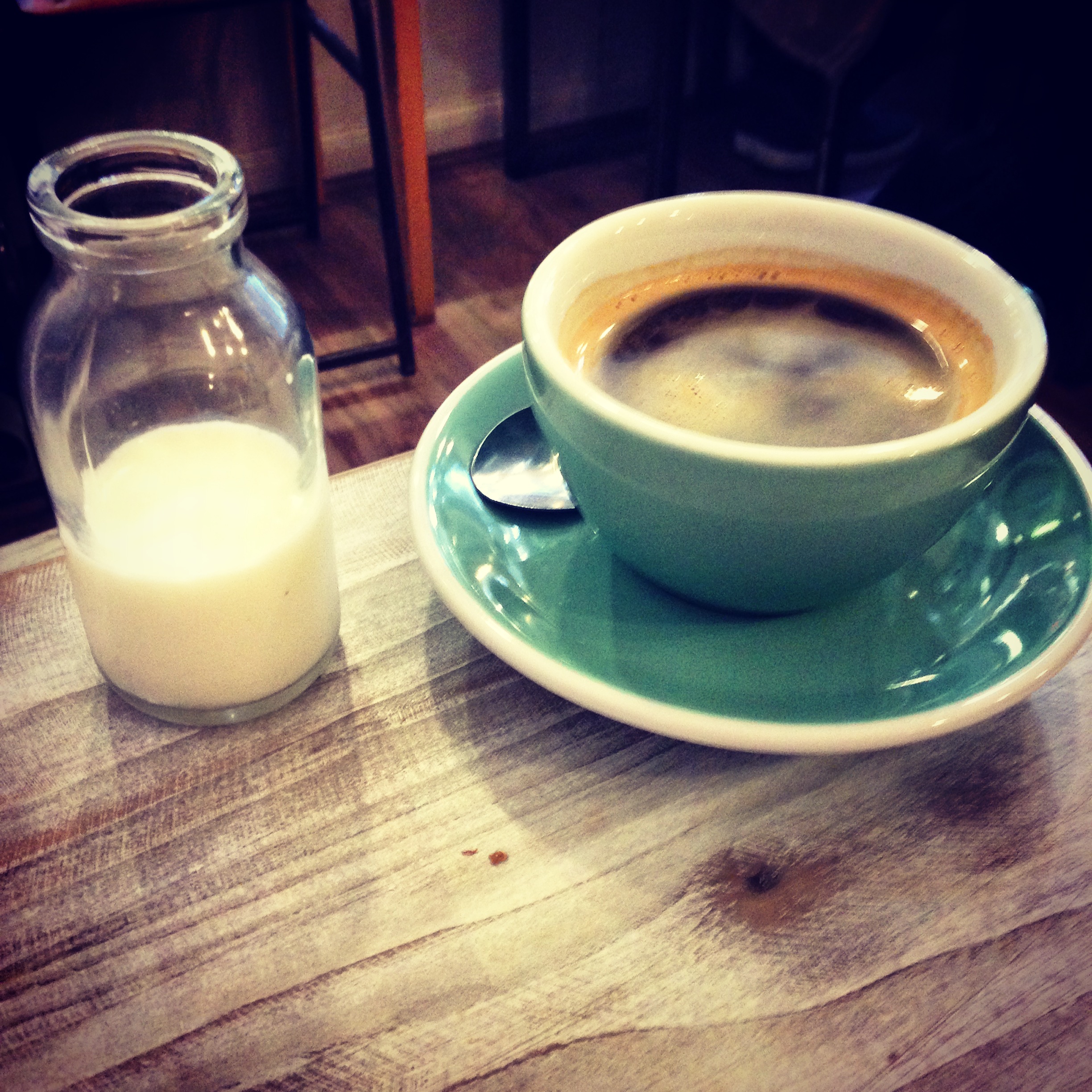
Brand consistency equals reliability, both a blessing and a curse (if you don’t live up to expectations). That’s why I like independent coffee shops. Oh, of course, many just get it wrong but when you find the opposite, someone who nails the ambience, the drinks and the food, they can’t be beaten. On my Ikonic Birmingham trip I discovered Faculty, nestled somewhat gloomily, in the Piccadilly Arcade close to New Street station. Why Faculty? I’m not sure. It’s too small to study there for a prolonged period of time and there don’t be seem to be Professors professorially conspiring around the eclectic collection of tables between lectures either. But there was a Chemistry Lab vibe hunkering down around a recycle and reuse ethic. I’m not sure the counter was made from old Chemistry classroom benches but it felt like (in a good way). The cakes most certainly weren’t though. The peanut butter brownie I had was from the grave: it was simply to die for. And the milk for the coffee in mini-urns was a nice touch. Next step: heat coffee for drip method with Bunsen Burners. Note to self.
Go there:
http://www.facultycoffee.com
@facultycoffee
Last night I went for a walk.
August 2011.
For some reason, the weight of intertwining issues had sidled, then slowly nuzzled up to me over a few weeks and was now nestling, snugly between my ears and even, at times, in my bowels. Why was I feeling unhappy? Why was this strange, invisible weight lying over me like a shot-filled duvet, pliant yet unmovable? I told myself what I would tell others: stand back from this. View your life, your situation, from the shoe’s of someone else. Goodyear Welted ideally, but we shouldn’t be picky. ‘You have a beautiful wife and fantastic children. You are living in a pretty English village with friends and family nearby. You have a new job, which although in the Capital, gives you flexibility, a good living and a new lease of life. What’s to worry about?’
Ha! I worried about the worry. Now feeling guilty that I was doing exactly what I chastise my worrying wife for. Perhaps, I was becoming so Middle Class in my Middle Age living in Middle England that I was searching for something bigger, deeper, more purposeful. Middle Life Crisis. Already? Didn’t Giles Coren write scathingly about this just the other week? It’s so European, so effete. I’m sure I agreed with him at the time.
But that wasn’t it. This wasn’t so deep. At least, not philosophically deep. Yet it was deep within.
I went for a walk. No map. Just legs, moving, onward. Walking where they took me. Onward.
Through the estate. To the Green Lane. Past a church. Down a bank. To the towpath. Approaching dusk, I danced between puddles and the hedgerow, along the canal. In the distance a slight, yet audible, mesmeric rumbling from the main road, slowly dimming with each step. I approached a bridge. Slender, long; from iron and concrete, not pretty, but offering a perspective view as it stretched away from me towards a distant steeple and old mill. The Quarter Mile Bridge they called it.

Intuitively, I moved forwards silently, not disturbing the peace that now closed in around me.
No revelation. No descent of inner calm upon me. Just a dart of blue on the edge of my vision. What was that blue? Azure? Too pale. Sapphire? Too dark. This blue had a familiar iridescence that I couldn’t immediately place.
Again. Below the bridge this time, yet gone more quickly than eyes could follow.
A Kingfisher, delicately alight on a branch by a hole in the bank, like an orchid’s flower held to its stem with a mere pinch. Eyeing me as fixedly as I was it.
Taking the same path, I returned. Up the bank by the overgrown kettle-hole and warren, pausing by the church once more to look back on the way I had come against the incoming tide of dusk.
The Kingfisher had been there all the time whilst I worried about my trivialities. Looming financial crisis? Lacking a clear purpose in life? The right job? What’s the worst that could happen? Looking for food. Avoiding danger. Raising its family. Conversing with swans. I resisted coming over all bucolic but knew something had clicked. I paused in the moment to enjoy the ecstatic ordinariness of the situation. The joy of ordinariness that has endured and is there now, if only I had stopped and noticed it.
From now on, I would.
Sparkling Miscellany
July 2014.
This is a journal of things. A celebration of the beauty of the ordinary and less ordinary; of day-to-day magic that goes unnoticed. It celebrates the present, the now, the moment, without looking too far forward. How, through grand design, serendipity or luckless emergence we have ended up with the fascinating, intriguing world that is all around us, yet passes us by.
It’s deliberately glass half full; noticing, celebrating and laughing with life’s little pleasures, life’s events; the bounty of here. By my reckoning, ordinary can be extraordinary, and our lives richer if we pause, however momentarily, to notice it. To see the sparkling miscellany of life that surrounds us.
 morningmistermagpie.com