Post and rail

We exist in a human scale world, yet it’s a deception
For others, different worlds are there, different planes
A mortar bee, bat, a world behind bricks, their building blocks of life
To a spider, an eight-legged world walks little further than a post or rail
No Tesco trips, their food aloft it seems, comes to them

IMG_2729 IMG_2728


Winter Days, Summer Nights

Whilst I am not a fair weather biker, winter cycling does challenge. Inevitably, boisterous walks with our dog or short intense, mist-shrouded runs take their place, exacerbated by a busy pre Christmas business schedule.  Yesterday though I fitted in a short ride: really, it was a late Autumn ride: with a bite to the air and the fallen leaves now a levée of pulped compost damming up behind the kerbstones like snow drifting against an exposed hedge or drystone wall. I wasn’t there, but my dad’s recount of the banks of snow up near Tegg’s Nose in 1956 came to mind, so vivid they were in the telling. Towards the road centre, the leafocaust was less intense, here a collage wallpaper print, the maples particularly picturesque. My tyres were skittish. Later I would buy some new ones to find more grip.

In the evening, I read some old blog posts, one from a now defunct blog I had called ‘The Speed of Bike’.  The contrast in this post was immediate: in a few short weeks the clouds of insects, the warm smells of cropped fields and plump, rich hedgerow fruits, gone,  replaced by the clear starkness and broad horizons of winter.  It is reposted below.

I have a circuit. If Map My Ride can be trusted it’s 15.3 miles but close enough for me to call it 15 allowing for rounding. It’s mainly flat, but not so flat to allow just a cruise. The initial 4 miles are a long drag, more than a false flat, less than a ‘categorised climb’, with a lumpy road surface and regular ripples across the road which make for an uncomfortable hammering for the hands. Then a long section, 8 miles which is flat cruising on resurfaced roads, before a final 3 miles that loops me back into the village. It’s my unthinking route – if I want a quick ride and don’t feel inspired to route plan, or just haven’t got the time, then I set off, happy to be unthinking.

That was my mode last night. A quick gap before tea for a breather. Autopilot on, concentrating on the sensations of the road not the ride itself – it may sound strange, but sometimes there’s equal pleasure in just turning over the pedals. Pulling up not just pushing down; counting revolutions as the tyres gently whirr on the tarmac; feeling the road through your handlebars. There’s a mesmeric intensity to it which takes me to another place.

Last night though, Mother Nature caught me out. Not by a blazing show of power – lightning; hail, brimstone. Rather through the gentle elongated light of Summer. As I pedalled, I tried to think of the words for this piece – but unlike my pedal strokes they didn’t flow in the ‘there and now’. It was a bigger, more holistic impression of ‘this is what makes the British countryside so special’. And it was the light most of all. Even two hours before sun down, the light was low. It stretched everything: trees ran across the fields like the bony hands of a skeleton; buildings were pulled outwards like play dough, with a soft shadow added from photoshop. And the air was still warm, melting away in front of me as I cycled – just like the butter my gran would melt on the side of the stove before dragged her bone-handled palette knife through it for the first round of toast.

And the bugs. Millions of nameless, swirling, random insects pinging off my jacket, leaving small pok-marks as their exoskeleton performed its protective task. So many that at times I had to turn my head away and steer through eyes askance down the road. If there is a Maker and we are all to be judged then I’ll need to confess my sins for the number I unintentionally snuck up and spat out.

At last, home. As the brakes ease me to a standstill, and I clip out of the pedals, the sense of sadness that comes from riding on a long summer evening. Like the Summer evenings of our youth, there is just the lingering desire for it to carry on forever.

Mistletoe

IMG_2553_fotorA day of little surprises yesterday, born out of the initial annoyance of a road closure. Making my way back from a meeting I was diverted off a main road onto a route of lithely wriggling ‘B’ roads, looping and curling round the hills, not sticking to the valleys as elsewhere. These particular country lanes took me up one side of the Malvern Hills, over the top through a wooded col and then down the other side into Great Malvern. Looking east from there is an endless vista; a great plain, with Malvern directly below and Worcester to the north east, Tewkesbury to the south east. The Malverns have a character like a spine – the knobbly vertebrae sticking out from a body that needs a good feed, a generous plate of suet pudding and mash, with spotted dick for pudding. And from these backbones, looking west, it is an entirely different panorama, entirely rural, rolling rounded hills like a tray of green velvet eggs, heavily wooded and hedged.

Autumn is well under way now, and the fallen leaves march down roads in unnaturally ruler-straight lines where the whirls and eddies fight to a standstill allowing them to congregate in the dead air below. The pulpy mulch softens kerbstones and hides pavements, people tread tentatively as if over-stepping onto a bowling lane. And the trees are bashfully nude, a few lingering leaves hide their modesty for a matter of days but as the sap sinks, the inevitable final act of the strip tease is soon at hand.

With it, nature’s first harbinger of Christmas is clear to view – the balls the trees were hiding – Mistletoe. I’ve never seen it in such profusion. Near Eastnor castle a whole stand of trees, slender, reaching vertiginously full of these dappled decorations, like rooks’ nests at the heart of the tree. In Great Malvern, near the outskirts of the town, a tree lined arcade of oaks and horse chestnut, each full, as if the tumbleweed mistletoe had rolled from the hills and bounded and bounced down hill, only to be stopped here, natural run off lanes. A beautiful sight – one which I have never seen in such profusion: Mistletoe is a parasite of course, piercing the skin of the tree, attaching itself then feeding from the tree’s sap, leach-like. Perhaps birds of feather flock together (carrying the seeds with them too) and a new collective noun is needed for the plant. One thing is for sure, it was clearly too early for modern-day Getafix’s to be up in the trees with their golden sickles removing it for the magic potion money reward of today: bundles on sale down the Garden Centre in time for  Christmas’s under-tree smooching. I give it three weeks, tops.

Vogons

IMG_2525_fotorUntil yesterday, I thought that the Hitch Hikers Guide to the Galaxy was a work of fiction. Turns out though that Douglas Adams was more of a seer: the Vogons have taken over. Whilst we may not be threatened with an interplanetary bypass, they have infiltrated every Parish and Borough Council planning body up and down the land. They have re-written procedures. Made things more efficient. And made things utterly opaque.

Our neck of the wood is characterised by river floodplains – broad, meandering rivers, oxbow lakes, levees, river terraces and floodplains. Our soils are rich with lovely river cobbles, rills of quartz running through them from aeons ago, then worn smooth by hundreds of thousands of years of gentle fluvial frottage. Each cobble is matt and sullen when dry but lights up, glossy, pearlescent when wet, sparkling with mirror-like beauty. Between the cobbles is thick clay, smaller stones and grit.

It’s the bloody grit the Vogons want. From the air, the Trent snakes north east, broad and shallow, an ancient transport thoroughfare. But either side are the scars: gravel pits and mounds; the machinations of engineers, the machines of extractors. The Vogon planners are in on this and with the weasel word-tunes they play, they charm us lowly naïve snakes: ‘New gravel extraction will create 11 jobs’; ‘New habitats to be created on site of former gravel pit’; ‘New leisure complex and family play area for Burton’.

Thousands of years of our land, gone in a week. Miles of hedgerow, teeming with life, rent and pulled, ripped, slashed, burnt. The shy and secretive bat; their world destroyed – at least they can take flight and – hope; but not the rabbit and their warrens or the badgers and their setts. A small price to pay? Meadows destroyed; ancient rights of way, removed of diverted. The seasonal ebb and flow of the trees foliage, cleaved apart, thrown to the ground, dragged off. The sad cry of the corncrake or piping lapwing left for the reserves on Springwatch or Countryfile, like some perverse Truman show theme park.

Anger. We would have stopped it of course, had we known. How could this be? This won’t happen on our watch. But we didn’t. We didn’t care, apparently. It went through with no objections.

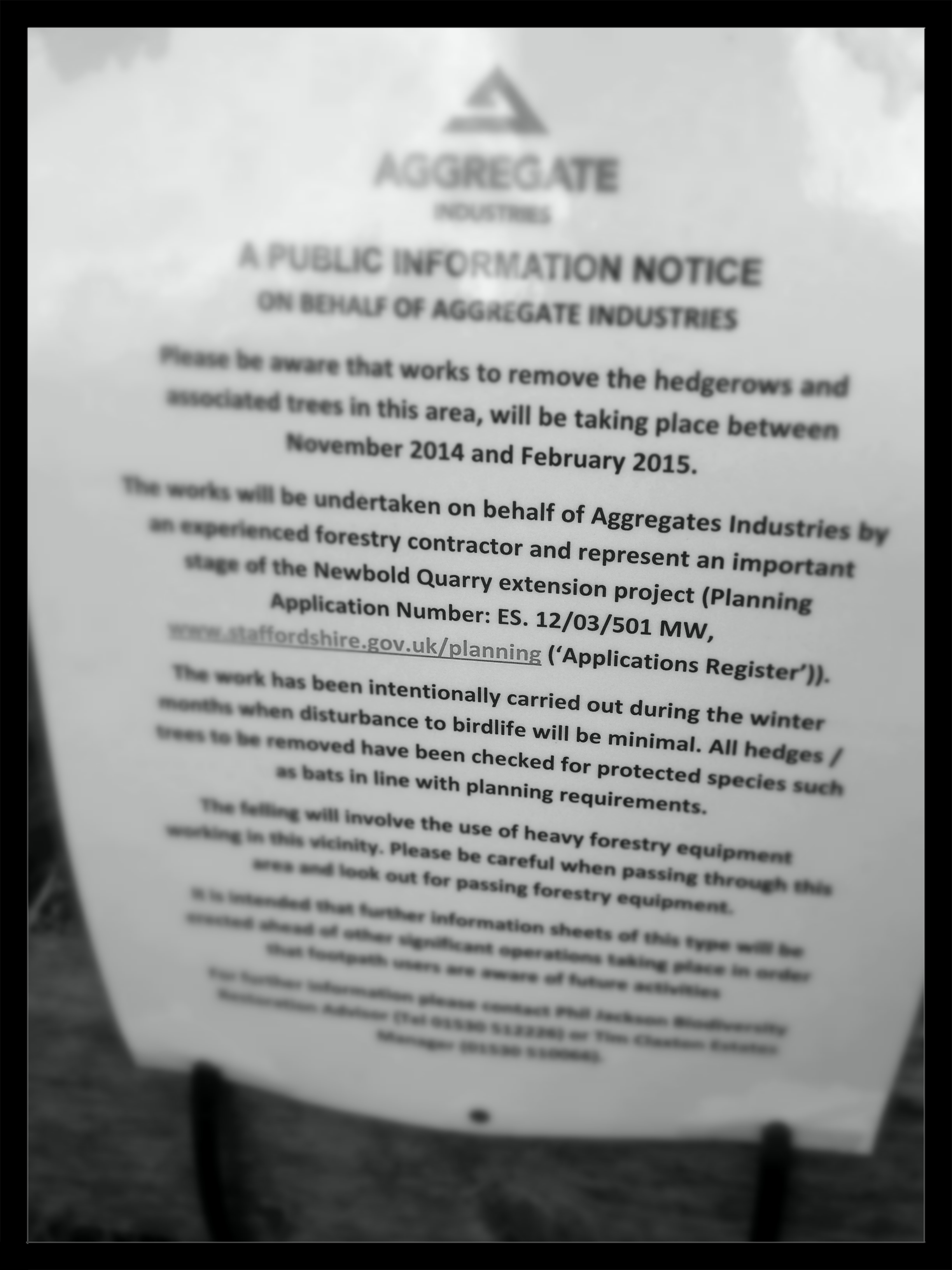
They told us it was going to happen. They put up posters. We can’t complain. We were given fair notice. They were on display for two weeks.

Yeah. In Alpha Centauri.

“A fine dewy morning”

A chill morning, the sparkling dew emphasising the intricacies of the spiders webs and leafless foliage. A fug of watery fog, low lying, birds sitting motionless as if under fright but then almost silently, rising as one and letting off songs of joy as though the joys of Summer remain above the cloud.  It reminded me of an old song:

Oh the lark in the morning she rises from her nest
And she mounts in the air with the dew on her breast
And like the pretty ploughboy she’ll whistle and sing
And at night she will return to her own nest again

IMG_2476_fotor

Early autumn jottings

September 2nd
An early start to Herefordshire, and the first sense that Summer ebbs as Autumn flows. From the broad valley with the Cotswolds on one side, and the Malverns the other, the M50 is the apple route. It becomes immediately more rural, and grassy. Rather than illuminated signs telling you to “use hard shoulder when busy” here they just say “Soft Verges”, a polite warning not to break down as the hedgerows will swallow you up. Then, outside Ledbury, the apple trees begin, defiant, proud, spiky despite huge stands that map the rolling lie of the land. They are heavy with fruit.

September 11th
With a strange circularity today, I meet an old colleague Giles. He worked for an advertising agency in Edinburgh who my old company used, and in 2001, we were up in the Scottish capital in a ‘pre production’ meeting, a critical stage in making an advert where everything about the forthcoming shoot gets agreed. During the meeting we heard the whispers. ‘Have you heard what’s going on in New York?’. Diverting the focus of the meeting, we watched transfixed. When the towers fell, it was impossible to comprehend what was going on. The setting was so familiar, so much like a movie set, watching it felt like one. But it was only in the taxi on the way to the airport and the flight home, that what had happened sunk in. We flew home.

IMG_2337The Plane trees in London are beginning to hunker down in preparation for winter. Leaf edges are curling up and turning cello brown. Some fall early; walking between parallel rows, the gravity of expectation is almost palpable. I don’t know why Planes are so named; but I have a soft spot for their versatility and constitution. Their fruit hanging like posh Christmas decorations, bulbous, glittering and furry; unlike conkers they don’t seem to fall. The Planes have adapted to thrive, like urban foxes.

I wait for my train at the British Library. To work at the library café it seems you must have an Apple computer, but they seem to sell very few apples at the counter, only cakes and excessively crusty sandwiches. It is though, to paraphrase ‘the restoration man’, George Clarke, ‘a great space’ and time passes quickly.

September 14th
I ride 62 miles on my bike, but feel unwell throughout. The land however is bursting with health and vibrancy. Climbing over the Chase under trees, I glance up at the canopies overhead. With the strong light behind, the canopies form patterns like fancy pants wallpaper, Laura Ashley, Farrow & Ball.

September 23rd
With the passing of the Autumn Equinox the daily stride towards darkness begins. And so too the bustle of Autumn, everywhere activity. As the sap in the tree falls as the days shorten, so the wind can starts its ironic late Spring clean, loosening the leaves’ attachment to their home.

The light lingers long now, backlit, iridescent. A short walk against brooding dark skies sees the hills lit up with spotlights. Greens are greener; the autumn colours commence, duns, browns, burgundies, reds. And the puffs of falling leaves have started. The horse chestnuts are letting go all around, a leafy mulch on the pavements. Other are less forthcoming, the oaks are still green, the little coins of the beech are preparing.

September 30th
This morning, low mist hangs over the fields and in places hill tops jut through, floating on the clouds. The sun is low. Bright reflections and long shadows of a leggy man striding across the fields. Squinting. And in the distance a swan, wing up, preens, preparing to hunker down.

The rook’s nest

There’s an ash tree in a corner of our land, a youth really, strident teenager, all lanky growth and fecund fertility. It throws off its keys with profuse thoughtlessness; blocking gutters, fertling their way into preposterously tight spots – lodging tenaciously underneath car windscreen wipers, tightly wedging themselves into window seals and muscling into the etched grips in shoe soles. Yet already, thoughts of chalara fraxinea are a shadow on the horizon just as it on so many blackened stands of this tree: will it find its way to our ash, separated as it is from its breathren or will it manage to keep its head down despite the fact it is reaching ever higher?

Certainly the jackdaws will miss it if it goes, the crows too. The jackdaws love Autumn, throwing themselves from the tree into the wind’s blustery vortexes, arcing and laughing as they do, sweeping up and round, wings outspread and curving; an air-fuelled dance with the breeze. The crows look on disdainfully, legs outspread along the fence top, braced, with their chokking caws, guttural, coughing. They would take to speaking Flemish with ease. The rooks though are above it all, aloof and aloft. A small family resident in the ash tree, probably moving into an old nest and then extending it, ignoring the planning laws, The Local Plan and Conservation Officer to boot. The nest certainly looked big from below, we would gaze up watching it grow, the rooks with their straight white beaks and glossy domed heads looking down on us, waiting for us to go.

Then tragedy. Violent wind, making the ash keys dance into the air like the crotchets and triplets of a musical melody line penned by nature, levered the nest out too: a finale to the score; the base drum, booming to earth. It landed in the night, the reverberations still felt the next day as the baleful drawn out cries of the rooks had vanished. With their home fallen, they moved on, seemingly without sentiment, their rebuilding must commence, this time elsewhere.

Screen Shot 2014-10-04 at 08.13.01
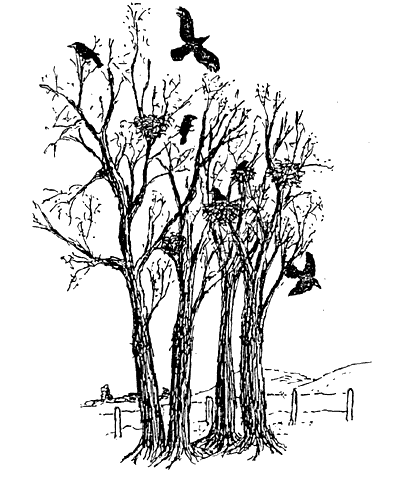
Image: courtesy http://www.wildlife-sound.org

For us the legacy was their nest; a prickly-edged oval, close on a metre long, two-thirds across, half deep; its scale up close shocked me. Like most of us, I had only ever seen the nests from afar, a jerky outline of a mess of sticks in a far off tree in a naked winter tree. But this was no jerrybuilt affair – they consulted Building Control after all. Tightly inter-woven with long flexible pieces of ash and dogwood, stripped of leaves and with strengthening braces running down, it was padded out with tufts of moss and wiry dried grass. Not neat and crisp like a wicker basket, but pliant and strong all the same. The wind that dislodged it had been ferocious: it needed to be to upend this home.

Now, the ash is home to woodpigeons and a new chorus has begun, the soft breathy woo and coo; the backing singers have stepped into the limelight it seems. Yet, just this last week, I chanced I saw a gothic feathery outline bouncily balancing in a neighbouring willow, a white beak, flashing like an epée this way, then that. Perhaps the rooks’ housing cycle is starting again.

Valley

The AA Guide to the British Countryside is now out of print. It was a hefty volume; thick spined and well thumbed; a reference book, not a book for carrying in your knapsack as you yomped down shadowed green lanes or across fields towards a distant stile. Yet it celebrated grand attractions and intimate views: from an old tree topped hill fort scarce noticed, to field patterns, to towns, cities or magnificent vistas; it celebrated special places up and down our isles and made places feel special in turn. It was designed no doubt, for long nights poring through its pages, planning roads trips; in reality it was a homage, suffused with a sense of place born of countless years of nature and man weaving their patterns on the land.

One of the glories of the guide was shining a light on the uncelebrated. One such uncelebrated place was the Blithe valley; a short stream, rising east of the Potteries and heading east again and south before joining the Trent. The name is thought to be Old English from gentle, which is perfectly apt; it is only a small river, which meanders lazily and somnolently through its willow lined valley, wet meadows and hedgerow still persist . The Guide, rather understatedly, described it as “the quintessential English country scene”.

It was mistaken though: the quintessential English scene is next door;  the next stream draining into the Trent watershed heading east, the Swarbourne, is more hidden, and quite different in character but equally everyday, equally unnoteworthy, so much so that like the many scenes like this, we take it for granted. The Swarbourn is a river of only 10 miles from source to confluence. Rising in the ancient Needwood Forest, unlike most streams, its valley is tightly bound through both its upper and middle reaches; it has more purpose, directness, yet remains humble.

John W_fotor

The source is a hidden spring amongst trees and leaf litter. Its foot, where it quietly merges with the Trent, you would hardly notice: there is a water meadow, bowing grasses and stately, tall reeds and then it is gone; only the Swans, surfing the short rapids here notice its influence. Between is the valley. Whilst it is narrow and steep sided it is not soaring. Cloaked with rich and varied woodlands in a patena of greens and browns; narrow paths snaking up through dappled shade, the verticality is emphasised, but it is a show. Lower down, the floor of the valley leads the eye on to a close perspective, shortening distance with softening trees and sharpened at its edges by unruly hedgerows of hawthorn and beech, reaching out into the road, brushing legs. Oaks, sporadically planted in the hedge, mark boundaries, overlooked corners, intimate meeting places. The river is never far away. Bridges here are simple affairs and now more beautiful because of it; low walled, flaking brick and stone; the arches unseen, easily filled by rising flow.  Fords are common too, with rutted lanes bouncing down to the rippling, running water, faster flowing over the drift-line.

In places the valley opens up just a little; but here the views explode out: a distant Church tower, a stand of brooding Scots Pine waiting to be climbed, a whale-backed field with the slow shifting spots of black & white cows; nearer to is an old cornmill, with apple trees dangling long arms over a speckled green pond, before squeezing in again, cramming the landscape back into a postcard window. The valley is its own world; longitudinal, like stops on the line.

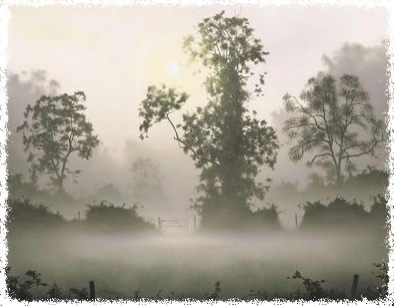
(Image: copyright, John Waterhouse; www.johnwaterhouseartist.co.uk)

Apple hop day

Over the holiday I read Wildwood by Roger Deakin. It is his quiet celebration of a life spent with trees; learning their ways, being amongst them; using their fruit, and in their second life, their timber, their tinder. What is striking is not just how different one species of tree is from the next, but how each tree is an individual: its burrs, its knots, its shape, its bifurcations; down to the separate world that lives deep within the folds and knurls of the bark itself; each in a way as a separate from one another as our cities; distinct but unique, able to communicate, an interdependency of richness. It is both an uplifting read and a soul-stirring one. As the story of our lost ancient woodland unfurls, as the realization of how much has fallen under man’s saw, then it takes on a haunting, elegiac quality; not in morose prose but in accenting the profoundness of our loss.

This week I was uplifted by trees though. Driving through the weaving, wandering, looping lanes of Herefordshire, one minute I would be surprised by the forceful push of large lorry wafting along a road built for carts, the next confronted by a green verge running along the road’s centre, high banked hedges and overtopping trees, their outermost leaves gently dangling and waving above your head. I had forgotten how that land is defined by short, steep hills, fields that pitch and flow into the distance and stands of ancient trees; uneven in height as the eye pans across them; uneven too in shape, colour, form. Trunks of brown; deep greens and grey; and, even at the start of Autumn, abundantly, vigourously plump with life, sap, fruity vitality.

Just outside Ledbury, heading west, is apple tree land. The trees follow the natural contours of the land, planted years ago in immeasurable stands forming today’s superficially boundless orchards. The apple seems a proud tree, rounded in form yet spiky close to; planted en mass yet independent, shapely, interesting to the eye. This year, apparently, has been a bad year for wasps and a good year for fruit. So it seems; trees lining the roads hang saggily under the weight of a large and ebullient crop; dessert apple in size; preening themselves with red-robin bellies to the sun. Earlier I had drunk some farm-pressed apple juice; it was rich, fat and delicious; now I looked forward to the fermented version from these same apples.

Later that evening, I inspected my hops. They’re ornamental not for brewing, but they snake and bind pleasingly through a corner of my garden; bullying some plants, clinging on to others, finding holes in my fence where knots have fallen out, and pushing through, looking for the sun. The cones are just passing their best but are still lime green and resinous, almost to the point of dripping their oils. Some I will dry; others I will put in the house for the aromas; most will be cut back in waiting for next year’s hop shoots and riotous cycle of growth.

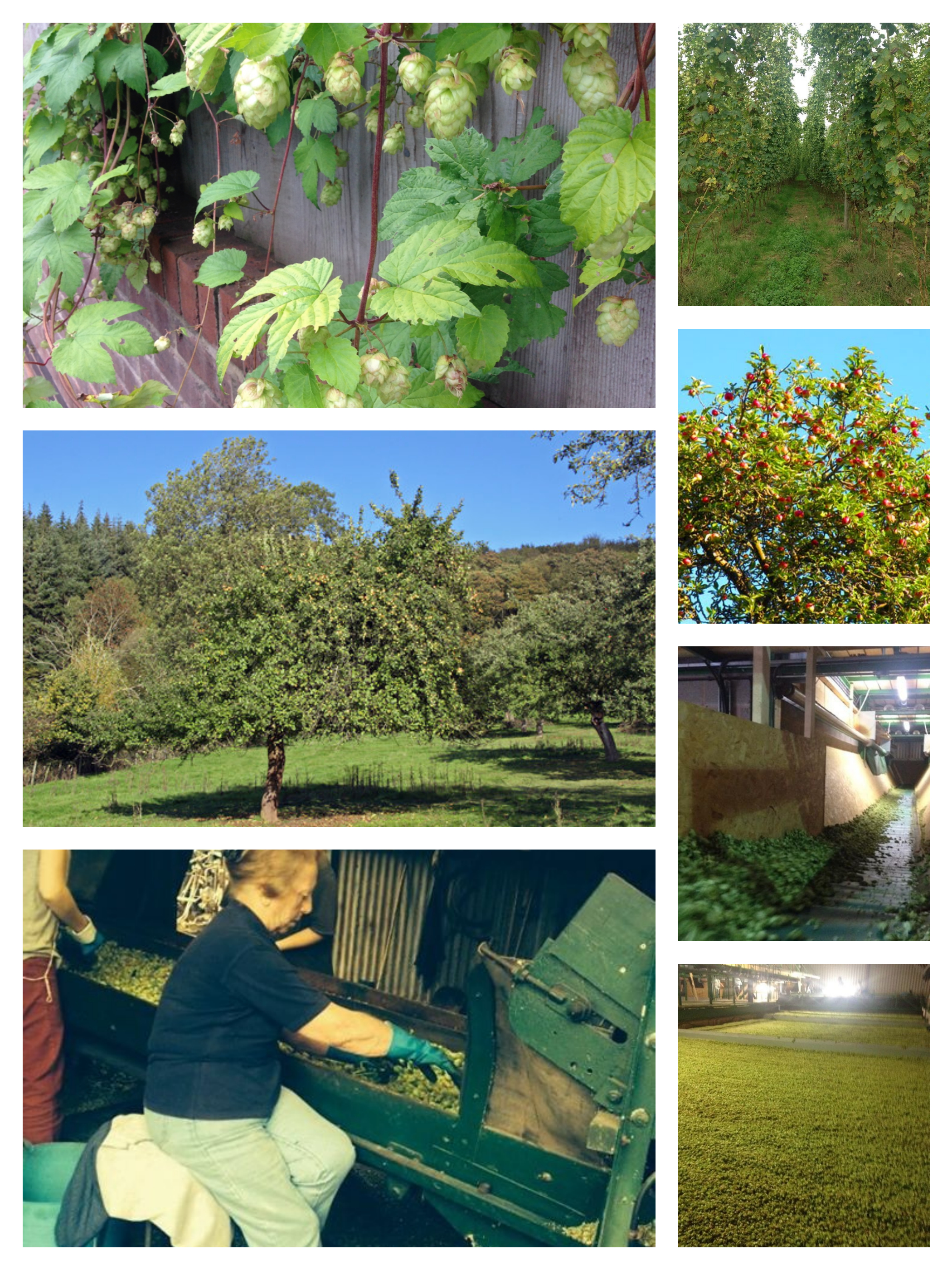
The apple-hop connection was only made later when a former colleague, Jo, posted some pictures of a Ledbury hop farm onto facebook. She had been to the farm the same day as I had been gazing on the apples and to watch their harvest; the bines twelve to eighteen foot; broad leaves like maples and dark, fleshy cones in bunches like a prize fighters fist. Most cones are stripped from the bines on a heath robinson contraption that cycles a hook round and round at head height; the bines dangle like a freshly butchered carcass before being sifted and sorted by hand and laid out like a thick pile carpet to dry. Like the fat apples, they spoke of spicy, citrusy, earthy beers to come; I licked my lips in anticipation.

For many, and for many a long year for me, cider and beer are like cats and dogs: you are a ‘beer man’ or a ‘cider man’; the fruit or the grain; the press or the boil. But nature doesn’t see it that way. In this thick tilled soil, on those rolling hills, both are at home; growing, ripening with the passing of the sun; blossoming richly in time for harvest and to sustain us all.

Also posted on www.beertintedspectacles.com 

Apple Tree in fruit_fotor