I met MJ for a catch up; his life more eventful than mine it seems, refreshed me. We talk and drank coffee, ate cake. Talked more.
Then we walked.
“But the beauty is in the walking – we are betrayed by destinations”
Gwyn Thomas
He wanted to show me something. Up New Street, across Victoria Square, past Birmingham’s Museum and Art Gallery and it’s Victorian grandeur. And across Chamberlain Square in memory to a great Victorian Statesman. By contrast, ‘Paradise Place’ is hardly that, a ’60s concrete juxtaposition, not even of the brutalist kind, just the memorably ugly kind. But pushing on we emerged by the new library – our destination, I thought.
But no. we carried on, through the ICC then along by the canal basin to emerge in the mish-mash of bars, restaurants and corporate offices making up Brindley Place. All a bit so so. Yet there, crouching off a pedestrianised & setted alley just off Broad Street was our destination. The delightfully off-centred Ikon Gallery (http://ikon-gallery.org).
I wished I had been more prepared mentally, as it was it was all a bit of a mental assault. MJ talked me through some of the pieces – but what struck me was the space. Some, open, clean, airy. Others, darker, cavernous, troglodytic. Worshippers stood in muted silence, in awe. Other gaggles giggled and moved on.
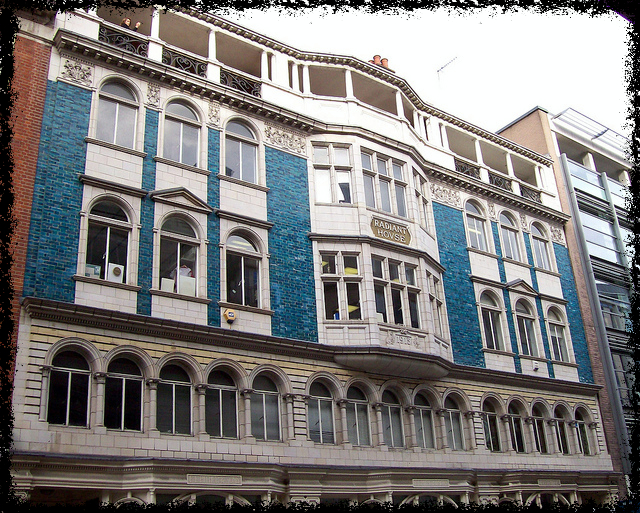
This is ‘Radiant House’ on Mortimer Street, just round the corner from my old office. I walked past it most mornings, always looking up, depending on the route I took from the station. I’m no architect nor architectural historian, but I know enough to see elements of classical styling with even touches of art deco (the wrought iron inserts on the top floor). Radiant indeed. Would we see aquamarine tiles on a building today? Yet look. Just below the name of the building is a smaller inscription. 1915. The year of the Dardanelles. Gallipoli. The Second Battle of Ypres. It’s difficult now to imagine the mood of disquiet & national depression as losses mounted up. Here is a beacon of hope, the building says.
I have two ways of thinking about clouds. The first is a Geography student and later Graduate fascinated by all aspects of our physical environment. What sort of clouds are overhead? What could that herald in the weather? Are we likely to experience thunder & lightning or worse, a West Midlands Twister (it always seems to be Birmingham* that gets hit. Is this some form of Divine Retribution?)? How many octas cloud cover are there. Rational things. Interesting to me; interesting to Tomasz Schafernaker** and probably still interesting to one of my old Geography teachers, Mr Lonsdale. But probably not interesting to a broader set.
The second is more absolute. Noticing clouds; enjoying them for what they are and most importantly how they frame the world that we look at. As I look out now, it’s almost a nursery school imagining of what clouds should be like: fluffy cumulus clouds, all rocky headed like cauliflower, tipped below with a minor threat of grey but otherwise bouncing along against a blue sky. Below, a stand of ancient trees – oaks and ash mainly – and to the side ‘Staffordshire Blues’ – not butterflies but tiled roofs, typical round this way.
But two clouds have alluded me. Oh, gosh, by writing that I sound like a cloud-catcher, but that’s not it. Here in the UK, we enjoy most clouds: from skittish cirrus, heralding yet another bout of rain, to hammer-headed cumulonimbus in deep Summer. Sometimes, in the hills, I’ve enjoyed the clouds below me, as I’ve ridge walked. But to this day, I’ve seen neither lenticular clouds nor noctilucent ones. Lenticular are saucer shaped ones, often in the lee of a mountain range: UFO like. For many years I travelled regularly to the American mid west and the foothills of the Rockies. Always glancing up but never seen. But last night, just briefly, I saw noctilucent clouds – just briefly and quite serendipitously (OK, I got up for a wee in the night. Happy now?). These are possibly the most magical: when the sun sitting below the horizon lights up ice crystals high, high in the atmosphere, effectively lighting the clouds from below.
The image is not mine, I couldn’t make a dash for the camera without disturbing the dog – but gives you an idea of why dedicated cloud spotters live a nocturnal life in the British Summer.
* As in Birmingham in the historic county of Warwickshire not Alabama – they’re probably as common as muck there. ** BBC Weatherman, dimensionalising our multi-ethnic society
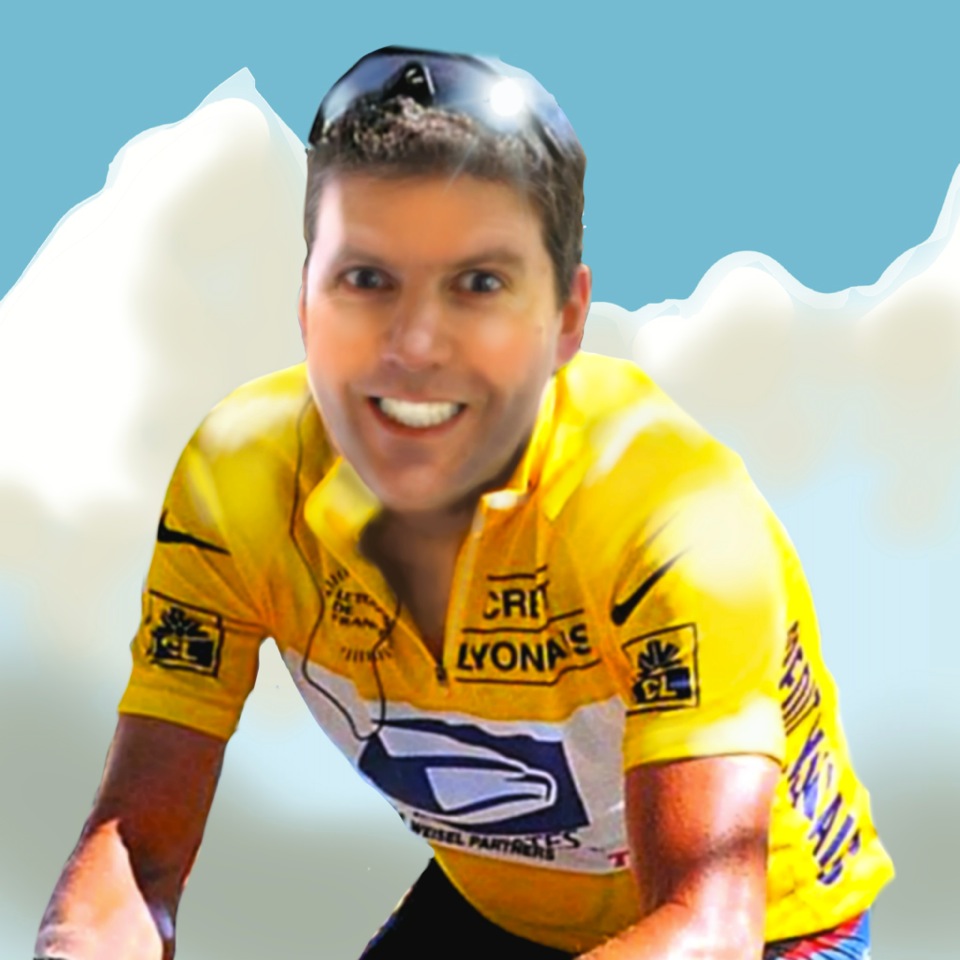
This blog was written just after the announcement – better, confirmation – that Lance Armstrong, like most of his contemporaries had drugged his way to victory in the Tours de France. As someone who had followed his story; the revelation, though unsurprising, indeed anticipated, still left an open, raw, feeling.
So we were living a lie then, all of us. The whole Lance Armstrong thang. Of course, it’s not the ‘Lance Armstrong thing’ of course, is it? It seems they were all in on the pop, every team, every nation, team Principals, oily rags… possibly to the very top of the sport (we shall see). The Festina Scandal of 1988 didn’t make any difference. Pantani sprinting up hills like he’s got wind behind him across the Polders of Holland time triallist, getting caught in the Giro at his moment of glory, eventually dying in his hotel room – didn’t make any difference. Athletes dying in the middle of the night as their hearts slowed to a standstill with their blood as thick as gazpacho – didn’t make any difference. No, it seems Lance and his partners just took it to a whole new level, and give him his due, did it well – 7 years of domination, pummelling, awesome rides as an individual and as team… all it seems powered by Kool Aid.
So where does it leave our memories, my memories? The year he returned from a cancer that had every right to kill him? He brought new attitude, new technology, new gear (his Time Trial helmet was like the head of the creature from the Alien movies), new swagger. I wanted him to win. To dominate. An English speaker, brushing away the cobwebs of fustiness and out-dated tradition. His mountain time trial epic on Alpe d’Huez as he sprinted past Ivan Basso. The year he almost lost, felled by a child’s musette, then slipping off his pedal to win by seconds in the final time trial against Jan ‘also on the pop’ Ulrich.
And what about Landis, and stage 17. Down and out, a proper ‘bonk’ the day before, dropping 10 minutes, to make a foolhardy attack 16 kilometres into a mountain stage… that stuck. Testosterone or no, it will be a ride that sticks in my memory. Because I can’t erase them. Those moments were real. They happened and yes, I am now disappointed, but the truth is they did happen and I watched them, right there, in the moment. I can’t go back, supplant them with something else. I can’t change the context. When Landis rode that stage, I kept on popping out of a day-long meeting like I had the runs, I had to see it, it was that gripping.
So now I have to draw a veil of guilty feeling across my mind separating the politically correctness of knowing that Armstrong is a swindler, with the other half, the devilish bit that knows how exciting it was back then and how he just raised the bar.
Or maybe there is a third way. Maybe over time my memories will fade and ‘truth’ and ‘perception’ will merge into a new reality. I can always hope can’t I?
My cycling life started accidentally, with my old Maths teacher, Mr Broad. I was 15, and my school was doing the equivalent of a rag week – raising money to build a new state-of-the-art music centre. Myself and a small peloton of friends, encouraged by Mr Broad, decided to ride a marathon – 26 miles at the time seemed mind blowing; a Roger Bannisteresque feat of endurance would be required. I might even have to pack Kendal Mint Cake, just in case. Needless to say, for a group of highly sporty and active 15 year old lads it was no problem, and I really enjoyed it. What I now recognise as my nascent sprinter kept appearing, dashing out from small groups, slipstreaming the group and flinging my Elswick ‘Turbo 12’ ahead of me to beat someone to the agreed lamp post or mile stone. When we got back to the school though, Mr Broad collared me and asked whether I cycled. I told him I did, in the way that any lad in the 1980s did – it was my only mode of transport other than pestering the folks, so, yes, of course I did. I misunderstood him; he misunderstood me, assuming I was actually serious. ‘Racing or touring?’ He asked.
‘Racing or touring?’
There, writ large, was the generational attitude of Brits towards cycling. Racing was for Belgians, Italians and the French. Touring, wearing tweed plus fours and a flat cap, no doubt, was what the Brits did. Racing was vulgar. Touring was healthy, vital, ours. Mr Broad was a tourer. He approved of the small pannier I had between my handlebars, but he disapproved of me un-sportingly slip streaming by peers….and celebrating.
The strange effect, which I have a small regret over, was that it made me rebel. My biking roots deepened through mountain biking – only without a steed worthy of such a name. I inherited my older brother’s Raleigh Rebel as a 10 year old (single speed, fixie, burnt orange paint scheme, white saddle, ineffective breaks) and because I wasn’t allowed a BMX, decided to ‘man up’ my wheels. Mudguard, off. Handle bars, changed. Tyres. Stolen from old bike. Despair all round parental quarters, but it makes me smile thinking of it today. In fact, one event has a strange circularity with Bradley Wiggins’ Tour victory and his proclivity for bowl haircuts, scooters and Parka jackets. Just opposite my mate Sean’s house was a bank on the edge of Poggles Wood where a large pipe emerged out of the ground and then ran on suspended brick pillars towards town. Of course, it became an integral part of our unofficial off-road cycling route. Trying to avoid the pipe, I learnt the lesson about which sequence you should apply breaks when descending by yanking on the front break, heartily pitching myself into a forward pirouette and face-planting in a bed of nettles. As I rolled over, groaning, I looked up at the pipe which was now four foot above my head. ‘MOD WANKERS’ it proudly declared.
So whilst I was at the bleeding edge of British mountain biking, road racing avoided my gaze until 1989….or 1987, which ever was the first year that Channel 4 screened it. Bizarrely, I think it was 1989, but I remember 1987’s race as if I had watched it all, now that I am a fully immersed cycling bibliophone. It doesn’t help that Adrian Timmis, who I first encountered within the pages of mountain bike magazines, rode the Tour that year and now runs a bike shop in our village. Memory and reality have merged and befuddled my aging cerebral cortex. The coverage was fantastic – without coming over as rose tinted, it was from another world. The colour; the scenery; the history; the characters; Paris. The soothing tones of Phil Liggett even back then. At University our whole house became Le Tour fixated, peering into our microscopic TV with its bulging glass screen like Pig Face’s glasses from Lord of the Flies.
This is a bally lot of gay fun
Indurain cemented my love of the mystique and beauty of cycling in place. Between those years of 1991 and 1995 it was though no one else would ever win the Tour again. Today he tends to be labelled merely as a great time triallist, but he was so much more than that. He was the most professional leader the race had seen to that point. He climbed with relentless power, rarely alone as his Banesto team around orbited, protecting him, bullying others.
But it was Landis who brought tears to my eyes for the first time (excluding face plants). This geeky, Amish rider, who had broken away to challenge Armstrong; riding with an eroded hip joint that needed to be replaced when the race was over. Who blew up on one climb only to stage the most incredible, audacious, pant-wettingly exciting attack the next day. It was the stuff of dreams. The rest of course, we know. But I believed him for a while. I thought it was a conspiracy by the organising body to ensure that anyone but an American would win. Gosh, how that would turn out.
Now of course, there is Bradley. His victory, and the incredible discipline and professionalism of the Sky team, is not just a monumental sporting achievement. It is the event that re-weaves the strands of British cycling. The sport is now in our cultural context as a sporting pursuit, one that we can do, what that we can excel at, one that we can teach lessons to others about. But it also buries the old demon that racing isn’t British and allows us to see the humble bike for what it most truly is: one of the most staggering of man’s inventions. An affordable formula one vehicle you can pop to the shops on.
There are some things that exist solely in your peripheral vision.
I find it fascinating that for most of our waking lives we concern ourselves with immediacies: what do I have to do today? Should I buy x not y? What will my wife think if I do n? Wasn’t there something I needed to do by 3.30pm? What do I need to get done next week? The old mind talk.
Yet, there all the time, never leaping out sufficiently to become the star of the show, are all the fascinating objects, events, people in our peripheral vision. The supporting cast if you will. There is a psychological explanation for this – your brain, processing as it does, millions of pieces of data every day, has to prioritise. Most things get de-prioritised. They don’t help the important tasks of survival or mating or shopping. Then an event happens – someone points something out for example – and suddenly, the bridesmaid has a chance of being the bride.
I spent my early years in the foothills of the southern Pennines. A large part of my family are from Congleton (‘Congy’ to those determined to make it sound even uglier than it does already). It’s a archetypal northern mill town. The Pennines rising up behind the town. Tall, thin, stoic mills, smeared brown and black with the grime of age still gripping the banks of the riversides. Houses, intermingled, in short, sharp runs of Ruabon brick and grey gritstone. Many of my family were mill people; my gran still bore a scar by her eye where a blurring shuttle had loosed and struck her. The mills were part of the weave and weft of their being.
So it was for generations that the water towers, rising sentinel above the town, had formed part of their peripheral vision, just as they had for me. Born out of necessity on many fronts, but chiefly to ensure the local populace (read: workforce) were not decimated by diseases like cholera, water towers became a feature on the horizon of many towns across the British Isles.
Funny then, that after almost 40 years, there were multiple events that crashed water towers from peripheral to primary vision in my life. It started with a chance encounter with The Renovation Man on Channel 4. Quite literally flicking through the channels one evening, the soft Geordie tones of the presenter eulogised the beauty of Victorian industrial architecture. I paused, assuming he was referring to a station or grand town hall. In fact, it was a water tower. Thinking little more of it, I hit record and went to bed.
Saturday, two weeks later. My Saturday routine. Drop the children off at the dance & acting class, buy newspaper, retire to the library cafe; read, write, or think. And there, outside the window is the most impressive Victorian water tower you will ever see: five stories high; topped with mock Norman arches and simple crenulations. A stone plaque: ‘1866’. I had parked next to it for almost twenty years with barely a passing thought- only now after working elsewhere and seeing it less, did I stop and take it in.
I went home the same day and found the recorded ‘Renovation Man’. It was a fine water tower’ a beautiful cylindrical design with mixed brick work of red and blue and fine feature arches. A functional building but designed with the pride and attention to detail that today is deemed an expensive luxury.
And I recognised it. Not with a vague familiarity, but a real sense of connection verging on déjà vue. In fact it wasn’t the water tower that drove this feeling, but the site and its sister; right next to it was a more modern water tower – a simple white structure; tank resting, shrouded in a concrete skirt resting on columns. Two towers, next to one another. This was Congy, the twin water towers standing out proud on one of the hills above the town and 40 years of peripheral vision became pulled into stark, sharp focus in an instant.
Most days I have a long commute: 2 hours, door to door. Fortunately, this is on our oft-derided railways so I get the chance to work, read, watch a movie or simply think – a real luxury in life. It’s true that our railways are expensive, particularly during the peak time window of 6am to 5.59am, yet despite this I still find travelling on trains retains the element of grandeur, of romance that you don’t get behind the wheel. There’s no logic to this: you are separated from the outside just as much, both are, if you stop and consider it, engineering wonders and both do a reasonable job of whisking you from A to B.
I mulled on this conundrum on my way home one Friday. My journey is from London’s Euston station up the west coast main line to Lichfield. I have got myself into a pleasant but costly routine of a post work latte and as I lifted up the lid, gently blowing on the froth to cool it whilst absent-mindedly shoo’ing pigeons out of the way with my leg, I glanced up to witness the answer – or at least the root of the answer.
‘Robert Stephenson, Civil Engineer. 1803 – 1859’
I remember being fascinated by railways when I was young boy, not as spotter, but rather in the engineering. The fact that motion could be produced from wood, iron, coal, water. The noise and the speed. Brought up near Crewe, my Dad an engineer himself, I learnt about that area’s engineering heritage and through a process of temporal osmosis, about the huge LMS engines that sped down the line at the end of Oak Street on the way to the north or the capital in a blaze of claret. Yet it wasn’t just the engines, it was the routes themselves – huge cuttings, lofty embankments, soaring bridges and the fascination that the rail I was looking at stretched without stopping 300 miles in one direction and 200 miles in the other. Evenly spaced and level all the way, someone had put it there. In fact, Robert was one of the people who put it there. And now he had snow on his head.
Robert had cropped up in my life before. He had built the Rocket for the Rainhill trials on the Liverpool to Manchester railway essentially through a bog. He built incredible bridges over the Menai Strait and the river in Conwy where we used to go for weekends away when I was growing up. And he was a Geordie so I was pleased that a northerner had done all this even though, at that point in my life I had never really crossed the Pennines. Later, I read LTC Rolt’s biography and realised that Stephenson was one of the greatest Victorian civil engineers – which if you consider the competition, was no mean feat. He had worked on gold mines in Columbia, surveyed for the Suez Canal and contributed towards the development of railways on continental Europe. And all this before his early death at 56.
Few realise the first engineering challenge as trains leave Euston today. It’s actually quite a climb – take the Northern Line to Chalk Farm, and then walk back and you’ll see what I mean. This meant two things – first of all an incline, and then a tunnel. Virgin’s Pendolino trains today are already approaching 125mph and beginning to tilt at this point but Robert had to design a separate pumping house and chains to give the under-powered engines a gentle hand. I understand the pumping house is still there and houses an arts centre which seems a pretty good analogy for industry in Britain today. Then the tunnel under Primrose Hill – this task was apparently so difficult that Robert must have considered dynamiting the whole lot and having done with it. Instead he painstakingly dropped vertical shafts to allow him to connect the various pilot tunnels and overcome the obstacle without impacting on house prices for London’s hipster creative set.
This task out of the way, the route speeds northwest through the Home Counties: Berkhamsted, Tring, Leighton Buzzard, Wolverton, MK… all in quick succession. Even on the slow trains you are Rugby in an hour. On a line first built in the 1830s. If all runs to plan, I’m climbing off the train 116 miles from Euston in 1 hour and 9 minutes. I’m not sure Robert would have imagined that travel of such speed and frequency would make commuting into London to work from the north Midlands something possible, and goodness knows what he would have made of the idea of trains travelling at 225mph but it does seem to me worthwhile contemplating the marvel of our railways today. This I think is what accounts for the difference of feeling when you travel this way. You leave from a station – often a grand one, you get an elevated view of the countryside around you and most days, in most weathers, you make it in quick time. For me it’s more than this. It’s the sense that your journey is so much more than this train on this day. It’s using the tracks, the vision, the sweat of those from generations before us.
That’s why, every morning I doff my metaphorical hat and say, “Good Morning, Robert”. We shouldn’t forget the contribution to our lives today of men such as him.
For some reason, the weight of intertwining issues had sidled, then slowly nuzzled up to me over a few weeks and was now nestling, snugly between my ears and even, at times, in my bowels. Why was I feeling unhappy? Why was this strange, invisible weight lying over me like a shot-filled duvet, pliant yet unmovable? I told myself what I would tell others: stand back from this. View your life, your situation, from the shoe’s of someone else. Goodyear Welted ideally, but we shouldn’t be picky. ‘You have a beautiful wife and fantastic children. You are living in a pretty English village with friends and family nearby. You have a new job, which although in the Capital, gives you flexibility, a good living and a new lease of life. What’s to worry about?’
Ha! I worried about the worry. Now feeling guilty that I was doing exactly what I chastise my worrying wife for. Perhaps, I was becoming so Middle Class in my Middle Age living in Middle England that I was searching for something bigger, deeper, more purposeful. Middle Life Crisis. Already? Didn’t Giles Coren write scathingly about this just the other week? It’s so European, so effete. I’m sure I agreed with him at the time.
But that wasn’t it. This wasn’t so deep. At least, not philosophically deep. Yet it was deep within.
I went for a walk. No map. Just legs, moving, onward. Walking where they took me. Onward.
Through the estate. To the Green Lane. Past a church. Down a bank. To the towpath. Approaching dusk, I danced between puddles and the hedgerow, along the canal. In the distance a slight, yet audible, mesmeric rumbling from the main road, slowly dimming with each step. I approached a bridge. Slender, long; from iron and concrete, not pretty, but offering a perspective view as it stretched away from me towards a distant steeple and old mill. The Quarter Mile Bridge they called it.
Intuitively, I moved forwards silently, not disturbing the peace that now closed in around me.
No revelation. No descent of inner calm upon me. Just a dart of blue on the edge of my vision. What was that blue? Azure? Too pale. Sapphire? Too dark. This blue had a familiar iridescence that I couldn’t immediately place.
Again. Below the bridge this time, yet gone more quickly than eyes could follow.
A Kingfisher, delicately alight on a branch by a hole in the bank, like an orchid’s flower held to its stem with a mere pinch. Eyeing me as fixedly as I was it.
Taking the same path, I returned. Up the bank by the overgrown kettle-hole and warren, pausing by the church once more to look back on the way I had come against the incoming tide of dusk.
The Kingfisher had been there all the time whilst I worried about my trivialities. Looming financial crisis? Lacking a clear purpose in life? The right job? What’s the worst that could happen? Looking for food. Avoiding danger. Raising its family. Conversing with swans. I resisted coming over all bucolic but knew something had clicked. I paused in the moment to enjoy the ecstatic ordinariness of the situation. The joy of ordinariness that has endured and is there now, if only I had stopped and noticed it.
This is a journal of things. A celebration of the beauty of the ordinary and less ordinary; of day-to-day magic that goes unnoticed. It celebrates the present, the now, the moment, without looking too far forward. How, through grand design, serendipity or luckless emergence we have ended up with the fascinating, intriguing world that is all around us, yet passes us by.
It’s deliberately glass half full; noticing, celebrating and laughing with life’s little pleasures, life’s events; the bounty of here. By my reckoning, ordinary can be extraordinary, and our lives richer if we pause, however momentarily, to notice it. To see the sparkling miscellany of life that surrounds us.
 I met MJ for a catch up; his life more eventful than mine it seems, refreshed me. We talk and drank coffee, ate cake. Talked more.




 morningmistermagpie.com