Mason’s marks

My Dad once told me off for looking down as I walked. He thought it showed a lack of confidence, a shambling man of the future maybe, losing his way in life, pushing a tartan shopping trolley.  Yet I was looking at sycamore keys as they gathered below the kerbs, some washing towards the drains, others interlocking, making knots, arboreal daisy-chains.

My gaze in cities is up; previous generations put detail into their upper storeys that today we shun as wasted effort, wasted cost. Elaborate Ruabon brick patterns in Manchester, mock terracotta facades in Birmingham, or iridescent tiles in Mortimer Street. Cupolas and pediments, often out of eye line; leading, curved and cut in flowing patterns, visible only to pigeons and skyscraper window cleaners.

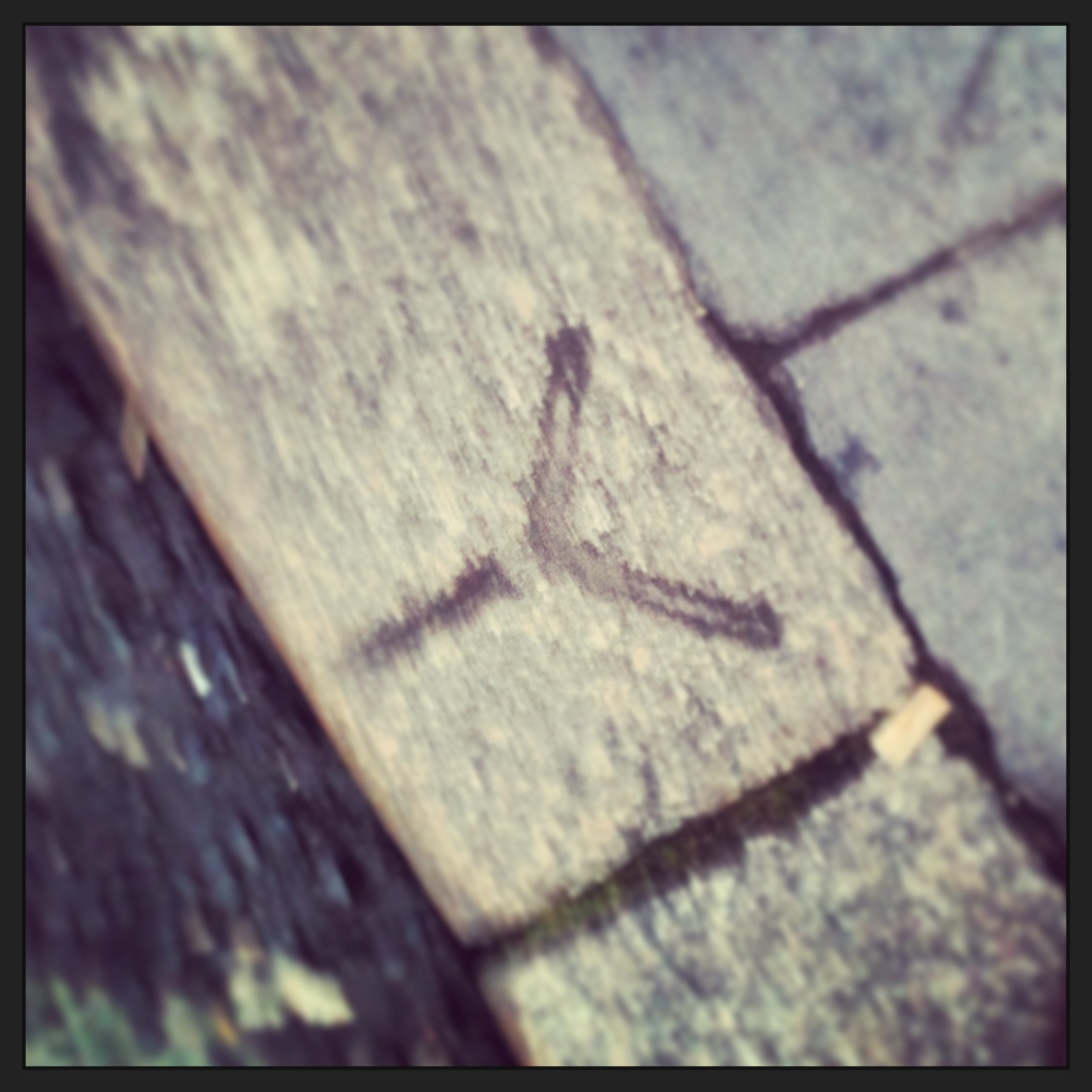
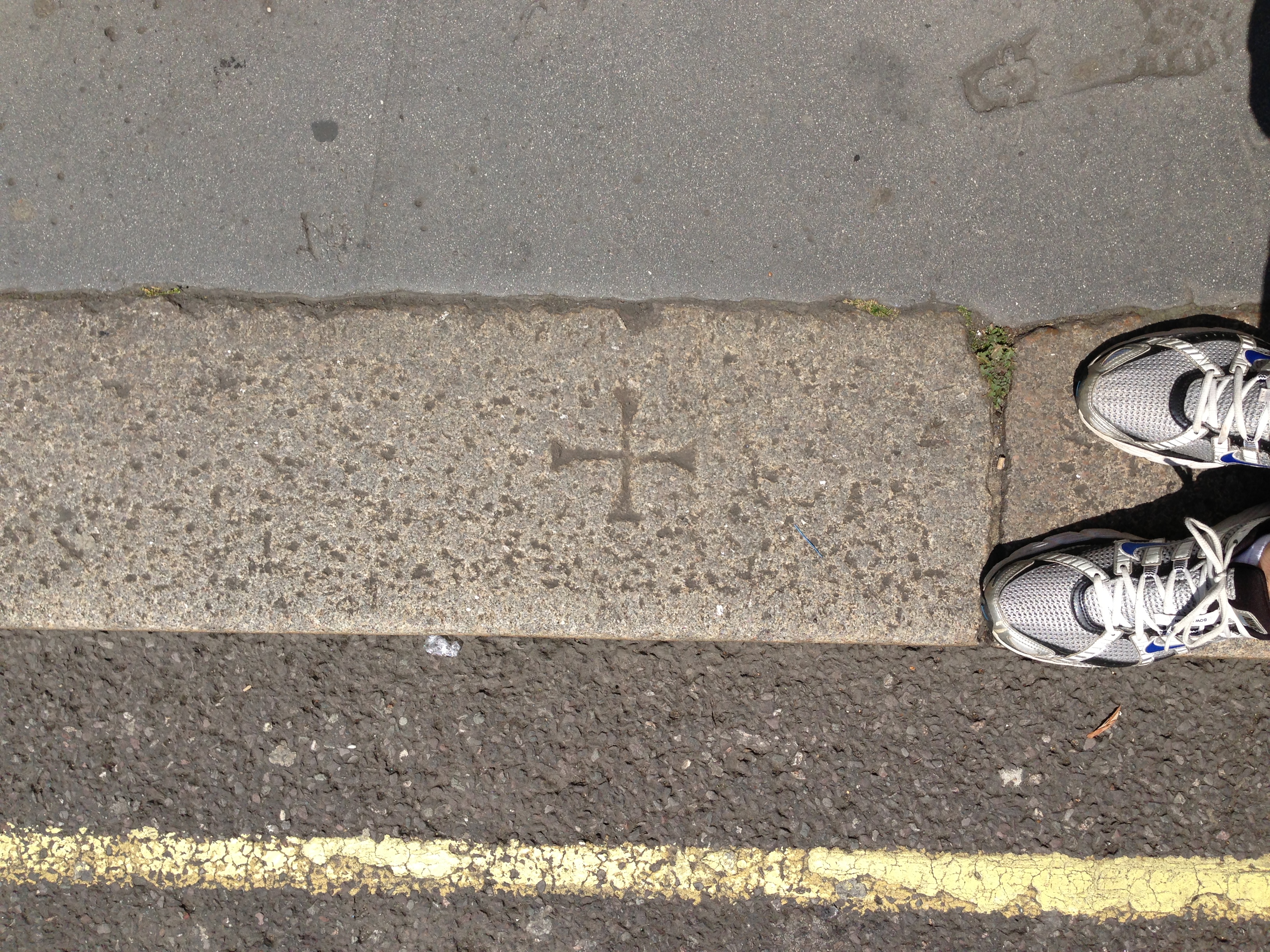
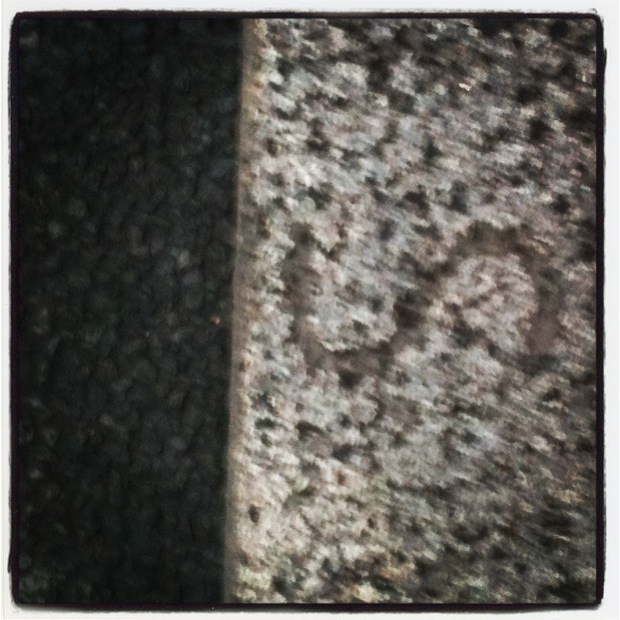
Yet there is merit in the downward glance too; wrought iron manhole covers proudly pronouncing their manufacturer. Thick glass tiles too, like old NHS glass lenses, which remind me of ‘Dan Dann, a  lavatory man’ in Carry on Screaming, for whom the tiles gave him his only natural light*.  But most of all, I’m intrigued by the mason’s marks on kerbstones.  Maltese crosses, diamonds, arrows, capital letters, even rune like symbols.  Were these early advertising? Merely a symbol of pride? Or perhaps a record for payment purposes?

IMG_2568 IMG_2566 IMG_0182

*That is, until Oddjob bopped him on the head and made his world go dark.

Which way up?

IMG_3039There’s a fishing pool near us of uncertain origin. It could be a kettle hole, where moons ago a lump of rotting glacial ice rested, covered in a blanket of debris, mulch and leaves, then caved in. It’s pock-marked with them round here. But it’s unlikely: the hand of man seems evident; too round, too shallow, too manicured.

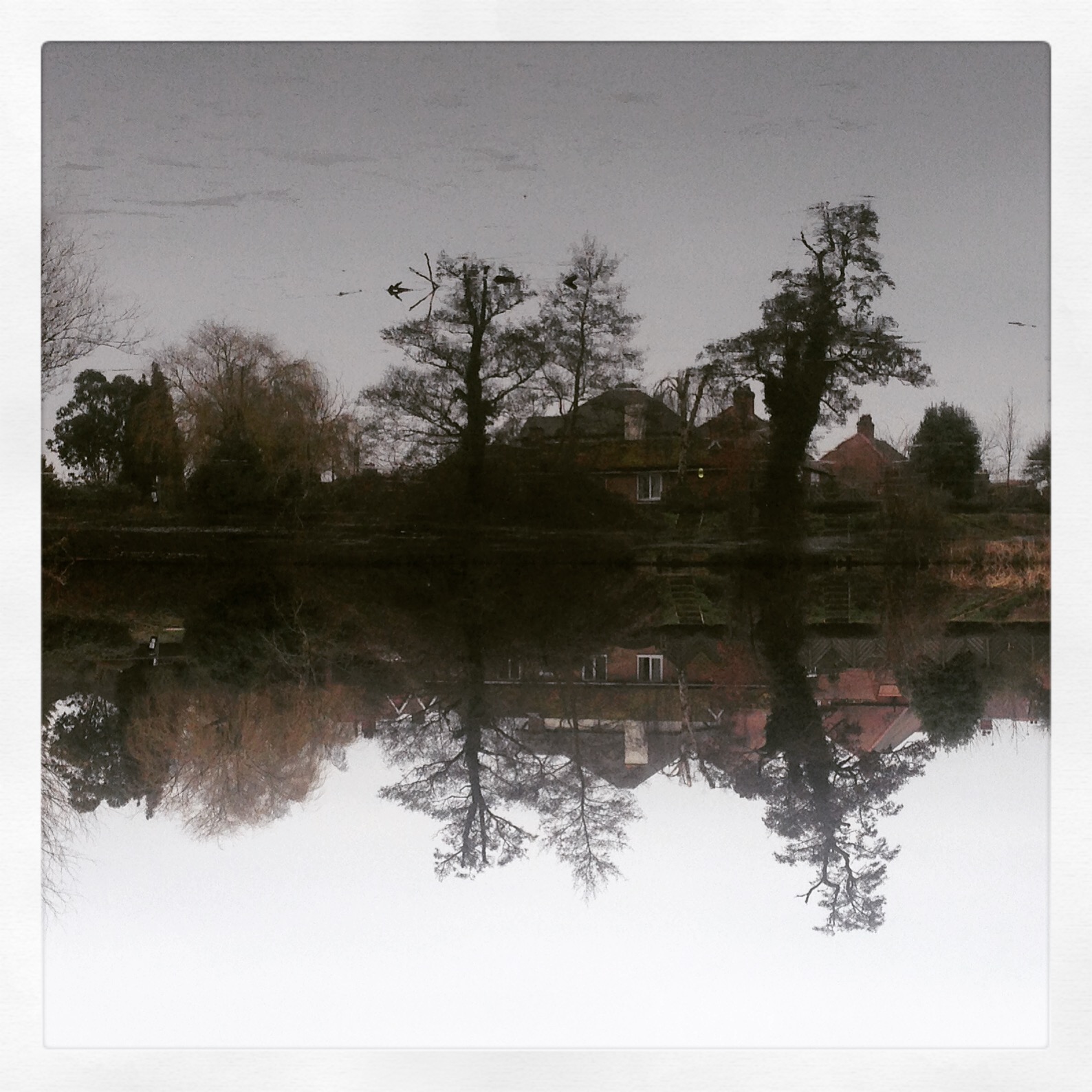
A pleasant spot all the same though; especially when the mercury drops. The ice freezes, edges first, then spreads in arcs, creating fantails, overlapping, like a decorator gone berzerk with Artex, or a child laying out Askey’s ice cream wafers in a pattern on the table.   The Moorhens are more skittish than ever as they bob across the ice, looking at their own reflections, walking like Egyptians.

A tennis ball rests on the ice, counting down to its own oblivion. The sticks may float to safety. And caught in a moment, perfect calm. Trees and houses opposite reflected symmetrically. Which way up?

Little bridges

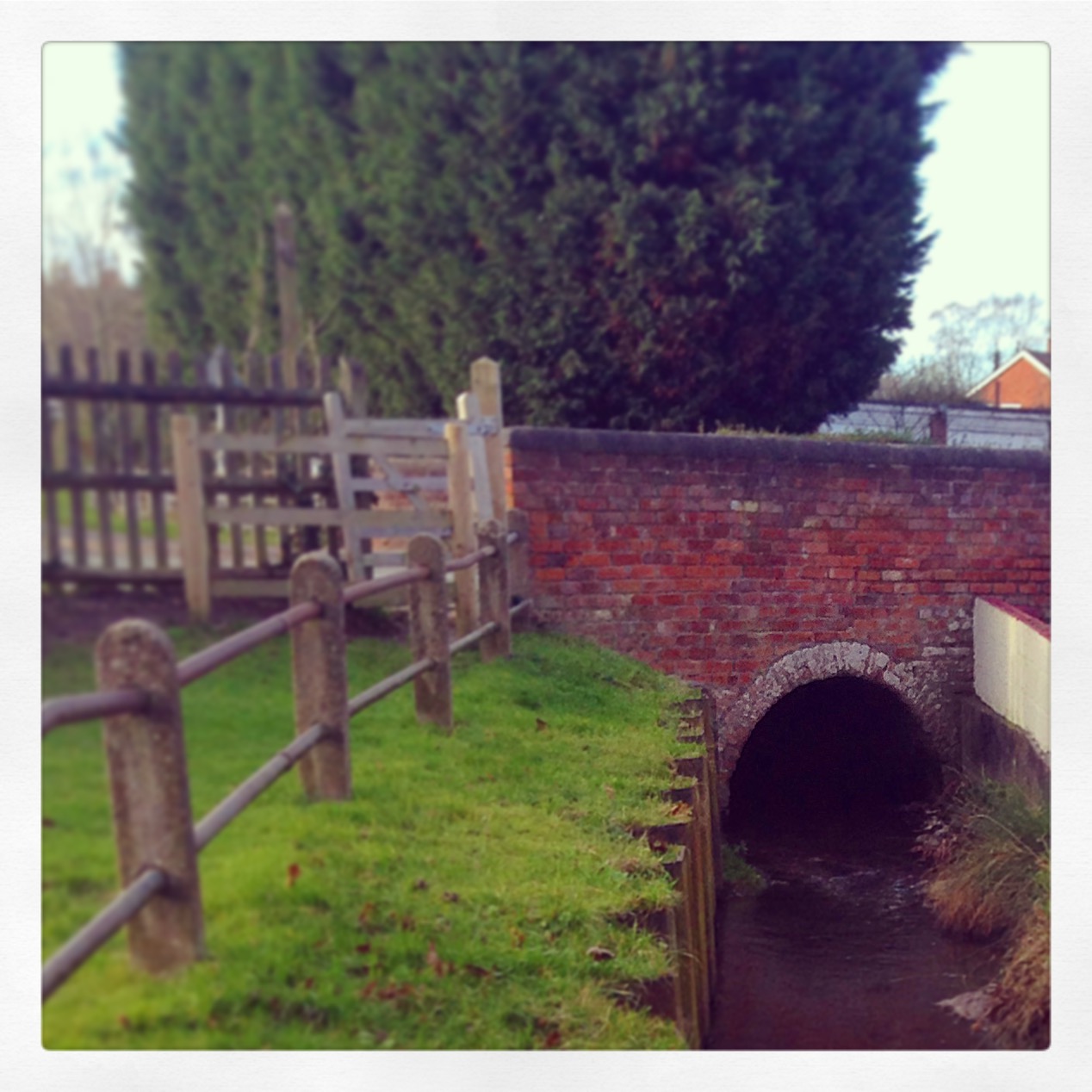
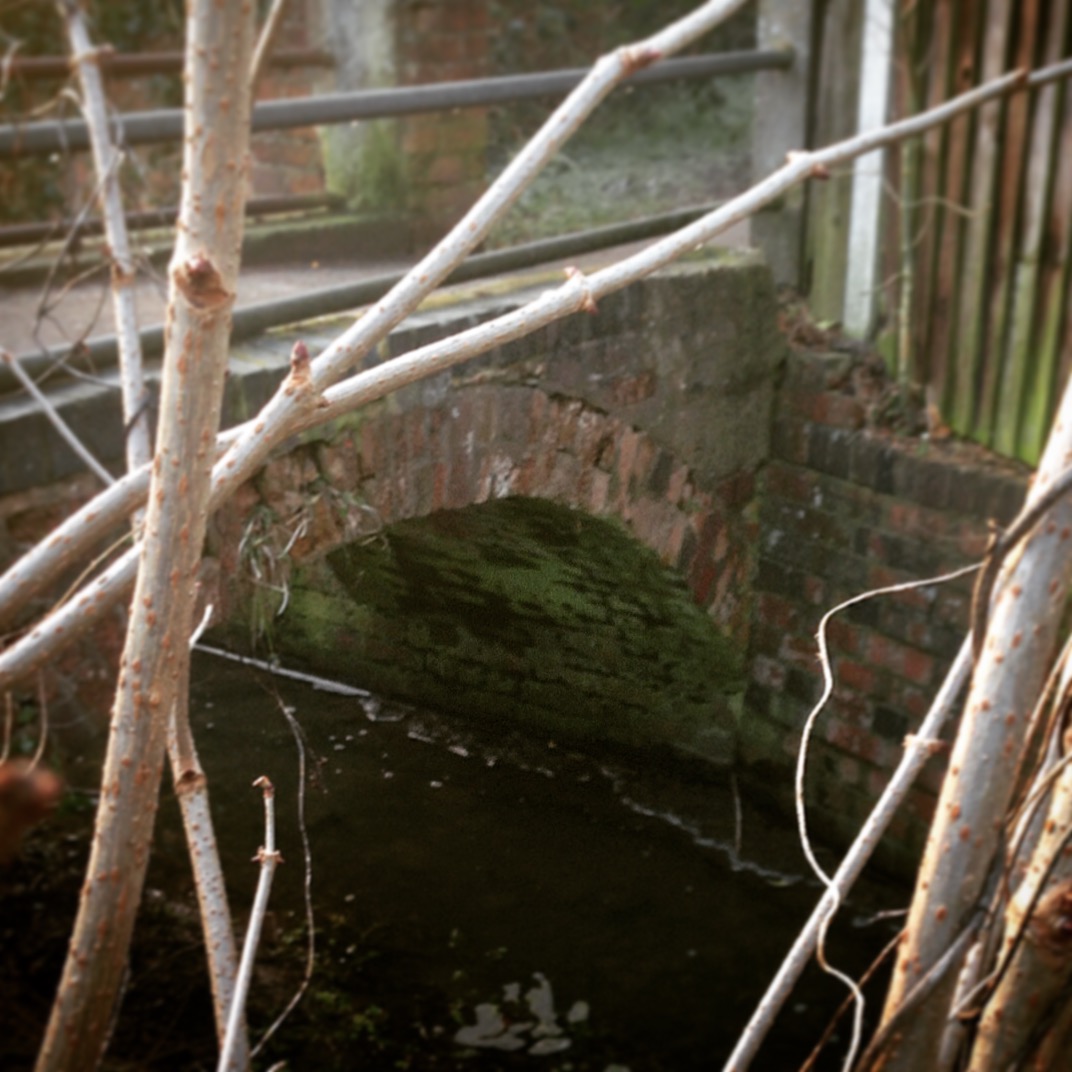
Building a bridge is an act of civilisation. Opening up new lands; connecting disconnected peoples; aiding trade; spreading language; sharing cultures, ameliorating war and destruction. Glorious bridges are celebrated: Tower Bridge; London Bridge; the Millennium Bridge, Sydney Harbour Bridge; Golden Gate; Brooklyn Bridge, Prague’s Charles Bridge. The Ponte Vecchio, The Bridge of Sighs. Mostar’s Stari Most, now rebuilt after the Balkan conflicts. France’s Millau Viaduct. Suspension Bridges: Brunel’s Clifton Suspension Bridge or Stephenson’s Menai Straits Bridge. The bridge over the Bosphorous in Istanbul, or the Pont Neuf in Paris. Yet all around us are smaller bridges, smaller acts of civilisation. Connecting one family with another; allowing the cattle to cross with dry hooves not plunge through a ford. Opening up a new snicket between two fields or a new road to a new estate. The little bridges are underfoot us all but hidden. Here, a quiet celebration IMG_2911 IMG_3032 IMG_3022

Longnix

grey_heron_ireland2_fotorA looming grey morning by the river, mist whispering through the bent reeds and feather-ended grasses that wave, regally, breezily. Afar, a loose brush stroke of blue; a distant sun illuminating the lower Peaks flourescently; shining like a glint of silver on an old clock face.

The longnix, the grey predator, stands stock still on the river bank. Her movements are imperceptible; geologic, intent-filled. Statuesque, she eyes a river rock pool, flush with bright gravel and water-oiled cobbles; previously I had seen her nestling under an overhanging tor worn smooth by the persistent, urgent caresses of the wind, in the long grass, hard staring the opal black water.    She is the hunter. Not a lion or wolf, but an assassin; she steps in and becomes the shadows; her neck is a spear gun, flaring, darting, incisive. A starter pistol, an instant reaction. The stickleback’s back is snapped back; then broken, swallowed, gone.

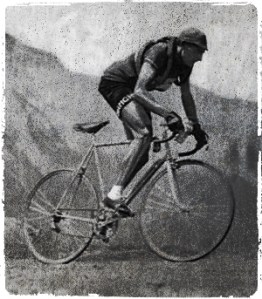
coppi_fotorDisturbed; longnix is unruly, comical. The take-off strained; loping, curving, sagging; struggling to make altitude before at last she is away, wings spreading and eventual grace. Built for stillness or flight; the rest, awkward.

Unawares, she transmutes into a champion cyclist; “il campionissimo”; thin limbed and lithe, knees knocking, walking like a baby giraffe or foal – best when still; then on the bike, the longnix stands, unfurls, opens up, wings spreading, takes off. Built for stillness or for flight, the rest, awkward.

Trees, gawping

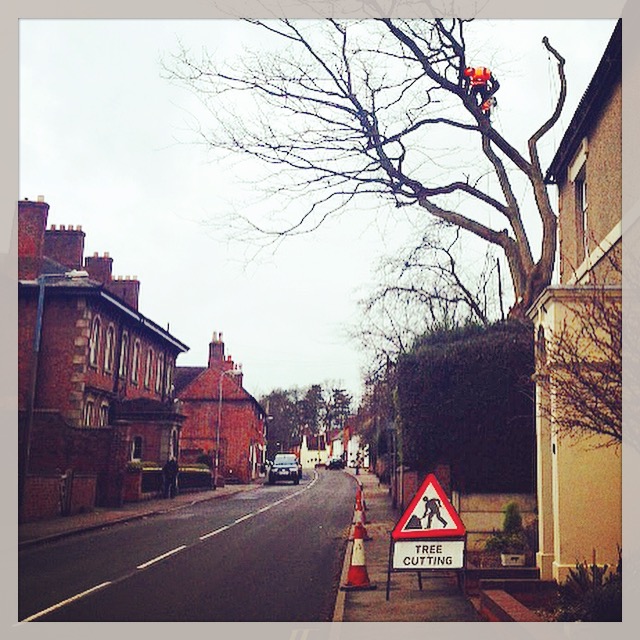
Earlier this week, a tree surgeon took whirring blades to some cheekily overhanging branches over our road. Shame really: I like it when the leaves are box-clipped as buses and lorries trim them from below.  At the moment though, the branches are naked and forlorn, unable to hunker down under their coat against the perishing icy blasts of the easterlies. Their cheek was exposed; the blades inevitable.

Unless, like me,  you are boreally disposed, trees typically disappear into the shadows; a key-line or highlight of dark matter around our expected views of the world; a penumbra. We notice them when they are gone, starkness revealed, but rarely celebrate them in life.  Strange then that as the day-glo clad forester did his work, there was a constant drip drip drip of an audience. Standing opposite, calling out, asking a question, or quietly noticing and enjoying the cropping and bobbing of the tree’s new styling. This tree softens the view down the road, the perspective teetering away round a bend in the distance. It’s gone now, but the main trunk remains, proud, strong, tall, ready to burst into new life with focused vitality in the Spring. A new vista will emerge.

IMG_2910

Low light

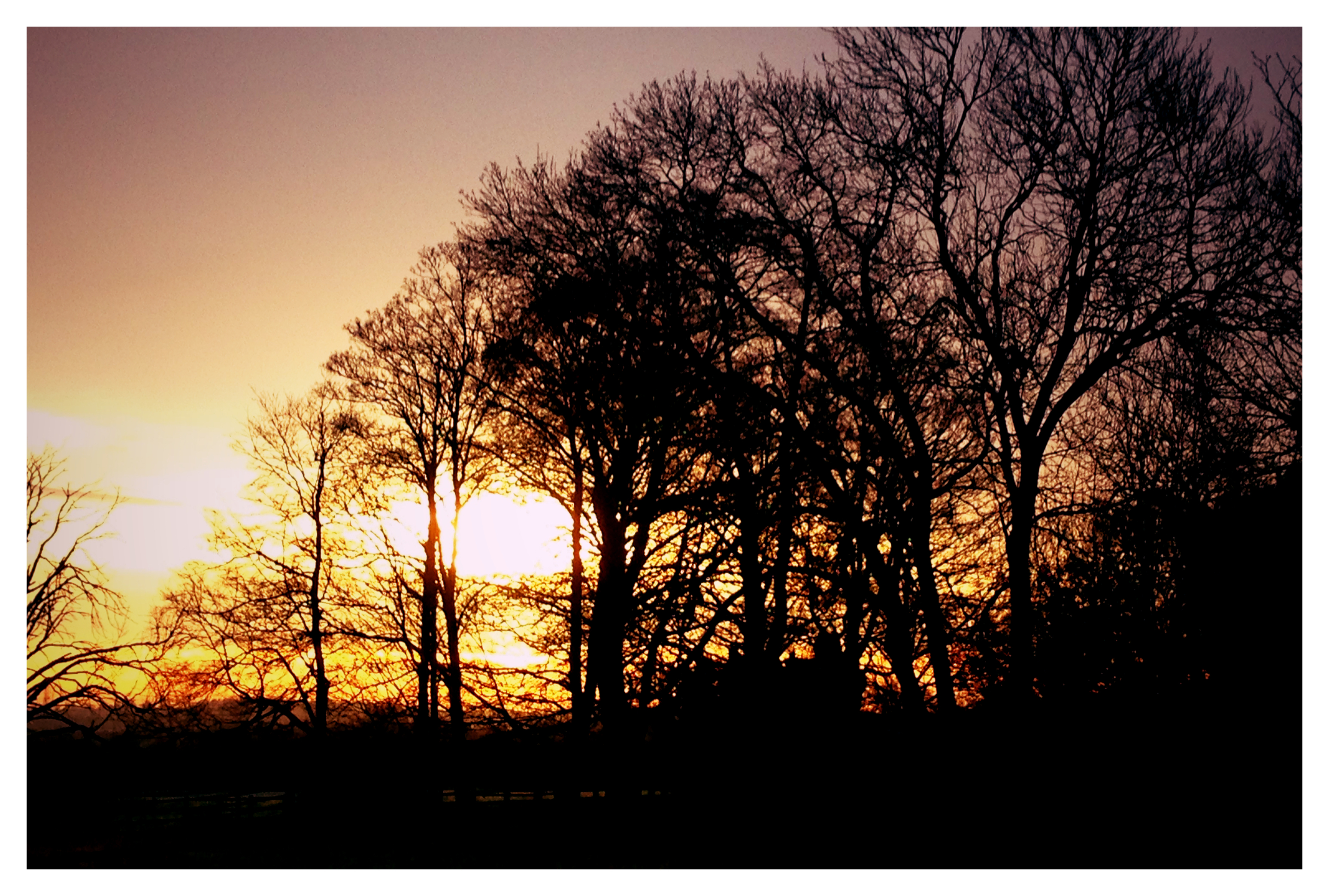
Early morning; it feels like I am heading east
But the low, back-lit winter sun scrambles over the horizon behind me
Sending lighthouse beams skimming over the grass
In a tree, slumbering pigeons blink to life
Chunky grey balls; camouflaged Christmas decorations

Dazzling flares of reflected light dazzle, hillbilly headlights
Mounted on ‘roo bars, off the panes of cheap double glazing
Chickens, loose in a field purr to life like an accelerating motorbike
Off in the distance

IMG_2827_2

Red sky

This morning, the warning, from he that tends the sheep
A watery sun, but the flames are not dowsed
It burns and scorches and chars
Yet all around ice, underfoot cracks
And lines the ‘rows with trident barbs, the frost king
Trees stand sentinel, their branches a candlelit silhouette
Root like, upturned against the bands of orange cloud

IMG_2786_2_fotor

Post and rail

We exist in a human scale world, yet it’s a deception
For others, different worlds are there, different planes
A mortar bee, bat, a world behind bricks, their building blocks of life
To a spider, an eight-legged world walks little further than a post or rail
No Tesco trips, their food aloft it seems, comes to them

IMG_2729 IMG_2728


Winter Days, Summer Nights

Whilst I am not a fair weather biker, winter cycling does challenge. Inevitably, boisterous walks with our dog or short intense, mist-shrouded runs take their place, exacerbated by a busy pre Christmas business schedule.  Yesterday though I fitted in a short ride: really, it was a late Autumn ride: with a bite to the air and the fallen leaves now a levée of pulped compost damming up behind the kerbstones like snow drifting against an exposed hedge or drystone wall. I wasn’t there, but my dad’s recount of the banks of snow up near Tegg’s Nose in 1956 came to mind, so vivid they were in the telling. Towards the road centre, the leafocaust was less intense, here a collage wallpaper print, the maples particularly picturesque. My tyres were skittish. Later I would buy some new ones to find more grip.

In the evening, I read some old blog posts, one from a now defunct blog I had called ‘The Speed of Bike’.  The contrast in this post was immediate: in a few short weeks the clouds of insects, the warm smells of cropped fields and plump, rich hedgerow fruits, gone,  replaced by the clear starkness and broad horizons of winter.  It is reposted below.

I have a circuit. If Map My Ride can be trusted it’s 15.3 miles but close enough for me to call it 15 allowing for rounding. It’s mainly flat, but not so flat to allow just a cruise. The initial 4 miles are a long drag, more than a false flat, less than a ‘categorised climb’, with a lumpy road surface and regular ripples across the road which make for an uncomfortable hammering for the hands. Then a long section, 8 miles which is flat cruising on resurfaced roads, before a final 3 miles that loops me back into the village. It’s my unthinking route – if I want a quick ride and don’t feel inspired to route plan, or just haven’t got the time, then I set off, happy to be unthinking.

That was my mode last night. A quick gap before tea for a breather. Autopilot on, concentrating on the sensations of the road not the ride itself – it may sound strange, but sometimes there’s equal pleasure in just turning over the pedals. Pulling up not just pushing down; counting revolutions as the tyres gently whirr on the tarmac; feeling the road through your handlebars. There’s a mesmeric intensity to it which takes me to another place.

Last night though, Mother Nature caught me out. Not by a blazing show of power – lightning; hail, brimstone. Rather through the gentle elongated light of Summer. As I pedalled, I tried to think of the words for this piece – but unlike my pedal strokes they didn’t flow in the ‘there and now’. It was a bigger, more holistic impression of ‘this is what makes the British countryside so special’. And it was the light most of all. Even two hours before sun down, the light was low. It stretched everything: trees ran across the fields like the bony hands of a skeleton; buildings were pulled outwards like play dough, with a soft shadow added from photoshop. And the air was still warm, melting away in front of me as I cycled – just like the butter my gran would melt on the side of the stove before dragged her bone-handled palette knife through it for the first round of toast.

And the bugs. Millions of nameless, swirling, random insects pinging off my jacket, leaving small pok-marks as their exoskeleton performed its protective task. So many that at times I had to turn my head away and steer through eyes askance down the road. If there is a Maker and we are all to be judged then I’ll need to confess my sins for the number I unintentionally snuck up and spat out.

At last, home. As the brakes ease me to a standstill, and I clip out of the pedals, the sense of sadness that comes from riding on a long summer evening. Like the Summer evenings of our youth, there is just the lingering desire for it to carry on forever.
Mistletoe

IMG_2553_fotorA day of little surprises yesterday, born out of the initial annoyance of a road closure. Making my way back from a meeting I was diverted off a main road onto a route of lithely wriggling ‘B’ roads, looping and curling round the hills, not sticking to the valleys as elsewhere. These particular country lanes took me up one side of the Malvern Hills, over the top through a wooded col and then down the other side into Great Malvern. Looking east from there is an endless vista; a great plain, with Malvern directly below and Worcester to the north east, Tewkesbury to the south east. The Malverns have a character like a spine – the knobbly vertebrae sticking out from a body that needs a good feed, a generous plate of suet pudding and mash, with spotted dick for pudding. And from these backbones, looking west, it is an entirely different panorama, entirely rural, rolling rounded hills like a tray of green velvet eggs, heavily wooded and hedged.

Autumn is well under way now, and the fallen leaves march down roads in unnaturally ruler-straight lines where the whirls and eddies fight to a standstill allowing them to congregate in the dead air below. The pulpy mulch softens kerbstones and hides pavements, people tread tentatively as if over-stepping onto a bowling lane. And the trees are bashfully nude, a few lingering leaves hide their modesty for a matter of days but as the sap sinks, the inevitable final act of the strip tease is soon at hand.

With it, nature’s first harbinger of Christmas is clear to view – the balls the trees were hiding – Mistletoe. I’ve never seen it in such profusion. Near Eastnor castle a whole stand of trees, slender, reaching vertiginously full of these dappled decorations, like rooks’ nests at the heart of the tree. In Great Malvern, near the outskirts of the town, a tree lined arcade of oaks and horse chestnut, each full, as if the tumbleweed mistletoe had rolled from the hills and bounded and bounced down hill, only to be stopped here, natural run off lanes. A beautiful sight – one which I have never seen in such profusion: Mistletoe is a parasite of course, piercing the skin of the tree, attaching itself then feeding from the tree’s sap, leach-like. Perhaps birds of feather flock together (carrying the seeds with them too) and a new collective noun is needed for the plant. One thing is for sure, it was clearly too early for modern-day Getafix’s to be up in the trees with their golden sickles removing it for the magic potion money reward of today: bundles on sale down the Garden Centre in time for  Christmas’s under-tree smooching. I give it three weeks, tops.